

Online Casino Security Explained: Staying Safe in 2025
Playing at an online casino should feel as safe as stepping into your favourite club on the high street. Yet, with every spin or card dealt, the worry about where your money and information go is real for many UK players. Understanding multi-layered casino security and why licensed sites monitored by the UK Gambling Commission hold your trust is crucial. Here, you will find straightforward insights on the latest safeguards protecting your data, how to spot a safe casino, and the real steps you can take to keep your gaming secure.
Table of Contents
- What Online Casino Security Means Today
- Types of Security Measures Used by Casinos
- How Encryption and Verification Protect Players
- UK Gambling Laws and Data Protection
- Key Risks and How to Avoid Scams
Key Takeaways
| Point | Details |
|---|---|
| Multi-layered Security | Online casinos implement intricate security systems, including encryption, verification, and regulatory oversight to protect user data and transactions. |
| Transparency is Key | Trustworthy casinos openly disclose their licensing, security measures, and use recognised payment processors to ensure player safety. |
| User Vigilance Matters | Players are responsible for their own security; employing unique passwords and enabling two-factor authentication significantly enhances account protection. |
| Know the Regulations | Familiarity with the UK Gambling Commission’s rules and data protection laws empowers players to recognise legitimate operators and safeguard their information. |
What Online Casino Security Means Today
Online casino security in 2025 is far more than just a padlock on a website or a password field. It’s a comprehensive, multi-layered system that protects your money, personal data, and gaming experience from fraud, theft, and exploitation. The UK Gambling Commission defines this framework as a complete package of measures that casinos must implement to protect their operations, customers, and data, including robust licensing, monitoring, and enforcement to ensure operators comply with national laws and fight crime. What this means for you as a UK player is that legitimate casinos must meet strict standards covering everything from how they verify your identity to how they store your financial information.
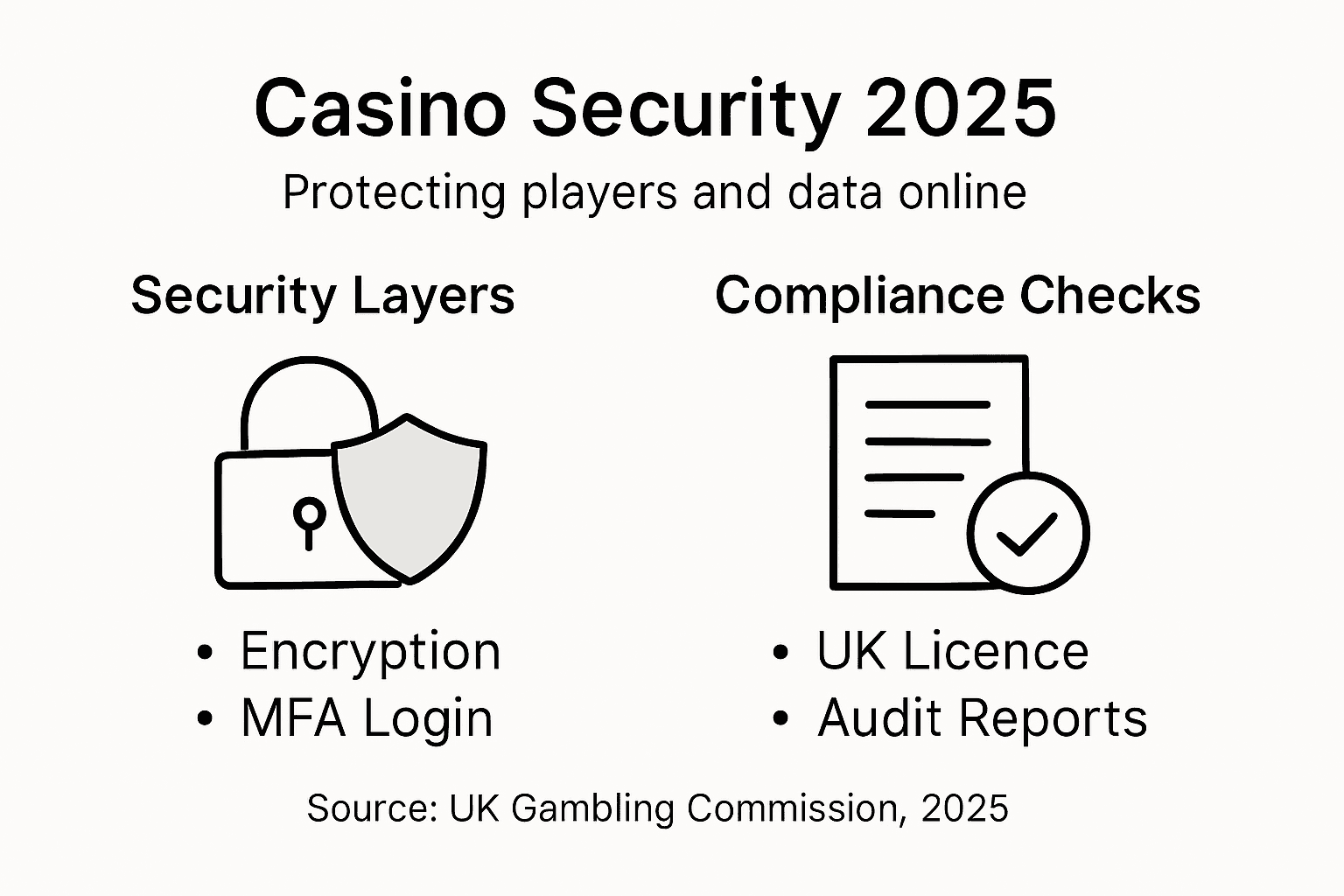
Modern security in online casinos operates on several interconnected levels. On the technical side, operators now employ advanced systems like encryption technology for data protection, digital surveillance, and facial recognition to identify cheating attempts and prevent fraud. Beyond the technology, casinos maintain exclusion lists, conduct continuous monitoring of player accounts, and implement anti-fraud measures that scan for suspicious patterns in real time. The UK Gambling Commission actively monitors licensed operators through regular audits and enforcement actions, ensuring they maintain these standards consistently. This creates a three-pronged approach: the casino’s internal security systems, the regulatory oversight from authorities, and the technological safeguards protecting your transactions.
What separates secure casinos from risky ones is transparency about these measures. Trustworthy operators publish information about their licensing status, display their regulatory certifications prominently, and explain their security policies in straightforward language. They use licensed payment processors with secure verification systems to handle deposits and withdrawals, implement account verification requirements that actually prevent unauthorised access, and maintain clear records of your transactions. You should expect to see security certifications from independent auditors, clear privacy policies explaining how your data is used, and responsive customer support that takes security concerns seriously. The reality is that if a casino won’t clearly explain how it protects your information or seems vague about its licensing status, that’s a red flag worth paying attention to.
Understanding what modern casino security means also requires recognising what you’re responsible for protecting. Whilst casinos build the fortress, you control the key. Your login credentials, two factor authentication codes, and device security all contribute to your personal protection. Legitimate casinos provide the infrastructure; you provide the vigilance. When you choose to play at licensed UK casinos that publish their security measures openly and submit to Gambling Commission oversight, you’re choosing operators that have already passed rigorous security assessments. This doesn’t eliminate all risk, but it shifts the odds significantly in your favour.
Pro tip: Check whether a casino publicly displays its Gambling Commission license number and allows you to verify it directly on the regulatory authority’s website before creating an account.
Types of Security Measures Used by Casinos
Licensed online casinos don’t rely on a single security method to protect players and their operations. Instead, they layer multiple systems working together, each designed to catch different types of threats. These measures span physical security protocols, technological safeguards, and compliance frameworks that operate simultaneously. Understanding what these systems actually do helps you recognise when a casino is taking security seriously and when it’s cutting corners.

The technological side of casino security has become increasingly sophisticated. Casinos deploy surveillance systems combining facial recognition technology with high-resolution cameras and automated detection tools to monitor gaming activity in real time. These systems don’t just record footage; they analyse behaviour patterns to identify suspicious activity that might indicate cheating or collusion. Encryption protects your financial data during transactions, ensuring that payment information stays scrambled and unreadable to unauthorised parties. Identity verification systems scan your documents and cross-reference them against databases to confirm you are who you claim to be. Additionally, casinos implement exclusion lists that flag self-excluded players or those banned for previous violations, preventing them from accessing accounts or placing bets.
Beyond the technology, casinos maintain rigorous operational security measures. Physical security personnel monitor casino floors and back-office areas, whilst supervisory staff conduct regular audits of gaming systems and financial transactions. Anti-money laundering programmes require casinos to vet customers thoroughly, monitor transaction patterns for unusual activity, and report suspicious behaviour to financial authorities. These AML systems comply with international standards set by bodies like the Financial Action Task Force, ensuring casinos don’t inadvertently facilitate financial crime. Casinos also maintain detailed records of all player activity, which they can review when investigating complaints or suspicious patterns. Customer support teams are trained to recognise social engineering attempts, where fraudsters try to manipulate staff into revealing sensitive information or bypassing security controls.
What separates genuinely secure casinos from lesser operators is how these systems communicate and complement each other. A casino might have excellent encryption but poor identity verification. Another might monitor transactions carefully but lack surveillance on the gaming floor. The best operators integrate these measures into a cohesive framework where each system reinforces the others. A suspicious transaction pattern might trigger additional identity verification checks. Unusual betting behaviour on the gaming floor might prompt staff to review encrypted chat logs. Exclusion list matches automatically flag accounts for manual review. When you play at a UK licensed casino, you’re benefiting from years of regulatory evolution and industry-wide security improvements driven by both compliance requirements and competitive pressure.
Pro tip: Look for casinos that publicly mention specific security certifications from independent auditors (like eCOGRA or GLI) and security standards they comply with, as these demonstrate investment in verifiable, third-party-validated protection measures.
How Encryption and Verification Protect Players
Encryption and verification work like a two-part lock on your casino account and payments. Encryption scrambles your sensitive data so only authorised parties can read it, whilst verification confirms you’re actually who you claim to be before granting access. Together, they create a formidable barrier against fraud, identity theft, and unauthorised account access. Understanding how these protections function helps you recognise when a casino is genuinely protecting your interests and when security measures are superficial.
Encryption operates on two fronts: protecting your data whilst it travels across the internet and protecting it when stored on casino servers. When you enter payment details or personal information into a casino’s website, encryption via HTTPS protocols scrambles that data into unreadable code during transmission, preventing cybercriminals from intercepting it mid-journey. Legitimate casinos use industry standard encryption algorithms like AES (Advanced Encryption Standard) and TLS (Transport Layer Security) to encode your information both during transit and at rest. This means that even if a hacker somehow gained access to casino databases, your payment card details and personal information would remain unreadable. You can spot encrypted connections by the padlock symbol in your browser’s address bar and the “https” prefix on the website URL. Encryption also protects your communications with customer support, chat logs, and betting history, ensuring no one can eavesdrop on conversations or manipulate records.
Verification processes work alongside encryption to prevent someone from accessing your account even if they somehow obtained your password. Multi-factor authentication requires you to prove your identity through multiple methods, such as entering a code sent to your mobile phone in addition to your password. Identity confirmation systems cross-reference your submitted documents against databases, confirming you match the identity you’ve claimed. When you first register at a legitimate casino, you’ll typically submit proof of identity like a passport or driving licence and proof of address like a utility bill. These verification checks happen again when you request withdrawals, ensuring money goes to the account holder and not to someone who’s compromised the account. Some casinos also implement biometric verification, requiring you to confirm your identity through facial recognition or fingerprint scanning, adding another layer of protection.
A critical point worth understanding is that encryption and verification protect different threats. Encryption secures your data from external attacks and eavesdropping during transmission. Verification protects you from unauthorised account access and account takeover fraud. A casino could have perfect encryption but weak verification procedures, or vice versa. The best operators implement both at full strength. You might see casinos advertising “SSL encryption” prominently; this is good, but it’s only part of the picture. Equally important is whether they require identity verification at signup and withdrawal, use multi-factor authentication options, and conduct regular security audits to test their systems. When evaluating casino security, look for casinos that mention both encryption standards and verification procedures clearly, as this indicates a comprehensive rather than partial security approach. The combination of these two protections means your money stays encrypted in transit, your account remains protected from takeover, and your identity is verified before sensitive actions occur.
Here’s a summary of how encryption and verification work together to protect online casino players:
| Protection Method | Purpose | Real-World Example | Player Benefit |
|---|---|---|---|
| Encryption | Scrambles data for security | HTTPS encrypting card info during transfer | Prevents data theft |
| Verification | Confirms player identity | Multi-factor authentication for logins | Blocks unauthorised access |
| Combined Approach | Layers protection | Encrypted data + 2FA login requirements | Defends against advanced fraud |
Pro tip: Always enable multi-factor authentication on your casino account as soon as it’s available, and use a unique password that you don’t use anywhere else; these two habits alone eliminate most common account compromise scenarios.
UK Gambling Laws and Data Protection
The regulatory framework protecting UK casino players operates on two interconnected levels: gambling law and data protection law. These aren’t separate systems that happen to coexist; they work together to create a comprehensive safeguard for your money and personal information. The Gambling Act 2005 and its subsequent reforms establish strict rules about how casinos operate, what they can and cannot do, and what happens when they breach those rules. Parallel to this, the UK General Data Protection Regulation (GDPR) and Data Protection Act 2018 govern how casinos collect, store, and use your personal data. Understanding this dual framework helps you recognise why legitimate casinos ask for so much information and why they’re careful about what they do with it.
UK gambling laws require casinos to obtain a licence from the Gambling Commission and maintain compliance with a comprehensive set of player protection standards. These standards include mandatory deposit limits that prevent you from spending more than you intend, age verification checks that stop underage gambling, and identity verification that confirms your identity matches your account. The Gambling Act 2005 mandates that casinos implement deposit limits and age verification checks to protect vulnerable players, though recent digital age reforms have tightened these requirements further. Operators must also conduct background checks on customers, review transactions for suspicious activity, and exclude players who’ve self-excluded or been banned. These legal obligations exist specifically because gambling carries real risks. When you play at a licensed UK casino, you’re benefiting from years of regulatory evolution designed to prevent exploitation and protect vulnerable populations.
Data protection laws operate alongside gambling regulations to ensure your personal information is handled responsibly. Casinos collect extensive data: your full name, address, date of birth, payment card details, and sometimes proof of identity documents. UK GDPR compliance requires casinos to process data lawfully, transparently, and securely, meaning they must tell you exactly what data they’re collecting and why. Casinos can only use your data for legitimate purposes like preventing fraud, complying with anti-money laundering laws, and processing your bets and withdrawals. They cannot sell your personal information to third parties without explicit consent, cannot use your data for marketing without permission, and must delete your data when you close your account (with limited exceptions for legal compliance). If a casino breaches these data protection requirements, you have the right to complain to the Information Commissioner’s Office (ICO), which can impose significant fines on violators.
The interplay between gambling law and data protection creates a unique challenge for casinos. They’re required by gambling law to collect extensive personal and financial data to prevent fraud and underage gambling. They’re simultaneously required by data protection law to minimise data collection and protect what they do collect. This tension actually benefits you. A casino cannot claim it needs all your personal information simply to allow you to play; it can only collect data necessary for legal compliance and fraud prevention. Similarly, a casino cannot hide behind data protection law to avoid cooperating with Gambling Commission investigations. Legitimate casinos are transparent about this balance, explaining clearly which data they collect and why. When evaluating a casino’s security posture, look for a detailed privacy policy that explains data collection, a clear terms of service that references their Gambling Commission licence number, and easy access to customer support that can explain their compliance approach. These indicators suggest a casino taking both gambling law and data protection seriously.
Pro tip: Before playing, verify the casino’s Gambling Commission licence number directly on the regulator’s website, and read their privacy policy to confirm they explain what data they collect and how they use it; this two-step check confirms they’re legally licensed and transparent about data handling.
Key Risks and How to Avoid Scams
Online casino scams exist in an ecosystem of other threats that target gamblers every day. Phishing attacks, fraudulent websites masquerading as legitimate casinos, account takeovers by criminals, and fake promotions promising impossible bonuses all circulate on the internet. The risk is real enough that dedicated security organisations track these threats constantly, and the sophistication of scammers continues to improve. What protects you isn’t avoiding online casinos altogether; it’s understanding how scams work and recognising the warning signs before you deposit money or provide personal information. The good news is that most casino scams follow predictable patterns, and with basic precautions, you can avoid nearly all of them.
Phishing attacks represent one of the most common threats you’ll encounter. A scammer sends you an email or text message that appears to come from your favourite casino, often claiming your account has been compromised or you’ve won a prize. The message includes a link directing you to a fake website designed to look identical to the real casino. When you enter your login credentials or payment details, the scammer captures that information and uses it to raid your account or steal your identity. The best defence against phishing is simple scepticism. Legitimate casinos rarely ask you to click links in emails to verify your account; they direct you to their official website directly. Verify that emails come from genuine casino addresses by checking carefully for subtle misspellings in the sender’s email domain. When in doubt, ignore the email entirely and log into your account directly through the official website rather than clicking any links. Phishing awareness and scepticism towards unsolicited contact are crucial protective measures that eliminate most phishing threats before they succeed.
Fake casinos and rogue operators present another category of risk that demands vigilance. These fraudulent sites collect your deposits, refuse to process your winnings, or disappear entirely with your money. They might have slick websites, convincing customer support, and professional-looking licences, but they’re all fraudulent. The way to avoid this entirely is to play only at casinos licensed by the UK Gambling Commission. Before depositing a single pound, visit the Gambling Commission’s website and verify the casino’s licence number directly in their official register. A licensed casino cannot hide this information; it must be publicly verifiable. Unlicensed casinos have no legal standing in the UK and no recourse if things go wrong. If you’re uncertain whether a casino is licensed, don’t play there.
Account takeover occurs when criminals gain access to your existing account through weak passwords, reused credentials, or social engineering. Once inside, they change your email address and password, prevent you from accessing your account, and either steal your balance or use your account to commit fraud. This threat is entirely preventable through behaviour rather than luck. Create a unique password for your casino account that you use nowhere else; reusing passwords across multiple sites means a breach on one site gives criminals access everywhere. Enable two-factor authentication whenever the casino offers it, requiring a second form of verification before you can log in or change account settings. Monitor your account regularly for unfamiliar transactions, unrecognised login attempts, or changes you didn’t make. If you see anything suspicious, contact customer support immediately and change your password. The combination of these habits makes account takeover so difficult that criminals will typically target easier victims.
Be wary of promotions that sound too good to be true, because they usually are. Scammers advertise impossible bonuses like “deposit £10, receive £1000” or “guaranteed wins” to lure players. Legitimate casinos make reasonable offers because they understand their mathematics and profit margins. Offers promising guaranteed profits or returns that defy casino economics are red flags. Similarly, be suspicious of unsolicited contact offering to help you recover gambling losses or promising access to “insider information” about games. These are manipulation tactics designed to extract money from vulnerable people. The safest approach is to make all your casino decisions on your own initiative through official websites, not through offers that come to you.
Here’s how common online casino threats compare, along with the best prevention strategy for each:
| Threat Type | Description | Main Consequence | Best Prevention |
|---|---|---|---|
| Phishing Attacks | Fake emails or texts tricking players | Stolen credentials/money | Ignore links, use official site |
| Rogue Casinos | Unlicensed/fraudulent operators | Lost deposits/winnings | Verify Gambling Commission licence |
| Account Takeover | Cracked or guessed passwords | Loss of account/funds | Unique password, 2FA enabled |
| Scam Promotions | Offers with impossible or guaranteed profit | Financial loss | Research offers, avoid unrealistic bonuses |
Pro tip: Before depositing at any casino, check three things: verify the Gambling Commission licence number on their official register, ensure the website uses HTTPS encryption (check for the padlock icon), and test their customer support by asking a simple question to confirm they respond professionally and quickly.
Protect Your Online Casino Experience with Trusted Guidance
Understanding the critical importance of online casino security in 2025 is your first step towards safe gambling. With threats like phishing, account takeovers and rogue operators becoming increasingly sophisticated, you need more than basic knowledge to stay protected. At Geeky Gambler, we prioritise the key concepts highlighted in this article such as encryption, verification, and UK Gambling Commission compliance to help you identify truly secure and licensed online casinos.

Take control of your gaming safety now by exploring our expertly curated reviews and up-to-date guides on licensed UK casino sites. Discover casinos that offer transparent security measures, fair bonuses and reliable payment options. Make informed decisions backed by verified information and real industry insights at Geeky Gambler. Don’t wait for risks to come to you when trusted protection and rewarding casino offers are just a click away.
Frequently Asked Questions
What are the key security measures used by online casinos in 2025?
Licensed online casinos implement a range of security measures, including advanced encryption technology, identity verification systems, digital surveillance, and anti-fraud monitoring. These systems work together to protect players’ data and ensure a safe gaming environment.
How does encryption protect my personal information at online casinos?
Encryption scrambles your sensitive data, such as payment details and personal information, making it unreadable to unauthorized parties during transmission and when stored on casino servers. This prevents data theft and ensures your information remains secure.
What should I do if I suspect a phishing attack related to my online casino account?
If you suspect a phishing attack, do not click on any links in unsolicited emails or messages. Instead, visit the casino’s official website directly to log into your account. Verify if the email is legitimate by checking the sender’s address for any discrepancies.
How can I ensure that the online casino I choose is safe and secure?
To ensure an online casino is safe, verify that it holds a valid licence from a regulatory authority, check for clear security policies, look for independent security certifications, and confirm that it uses HTTPS encryption for secure transactions.


