

How to master casino game selection workflow: UK guide
TL;DR:
- Smart game selection relies on understanding player profiles and matching RTP and volatility to goals.
- Always verify game licensing and check in-game RTP and volatility before playing for informed choices.
- Following a structured workflow enhances session enjoyment, prolongs playtime, and promotes responsible gambling.
Hundreds of new titles land on UK casino lobbies every month, and choosing where to start genuinely feels like a full-time job. The difference between a frustrating session and an enjoyable one often comes down not to luck, but to preparation. Having a clear game selection workflow means you spend less time scrolling and more time playing games that actually suit your style, budget, and risk appetite. Whether you are brand new to online casinos or a seasoned player looking to sharpen your approach, this guide walks you through every step of smarter game selection in 2025.
Table of Contents
- Understand your player profile and preferences
- Essential criteria: RTP, volatility, and provider licensing
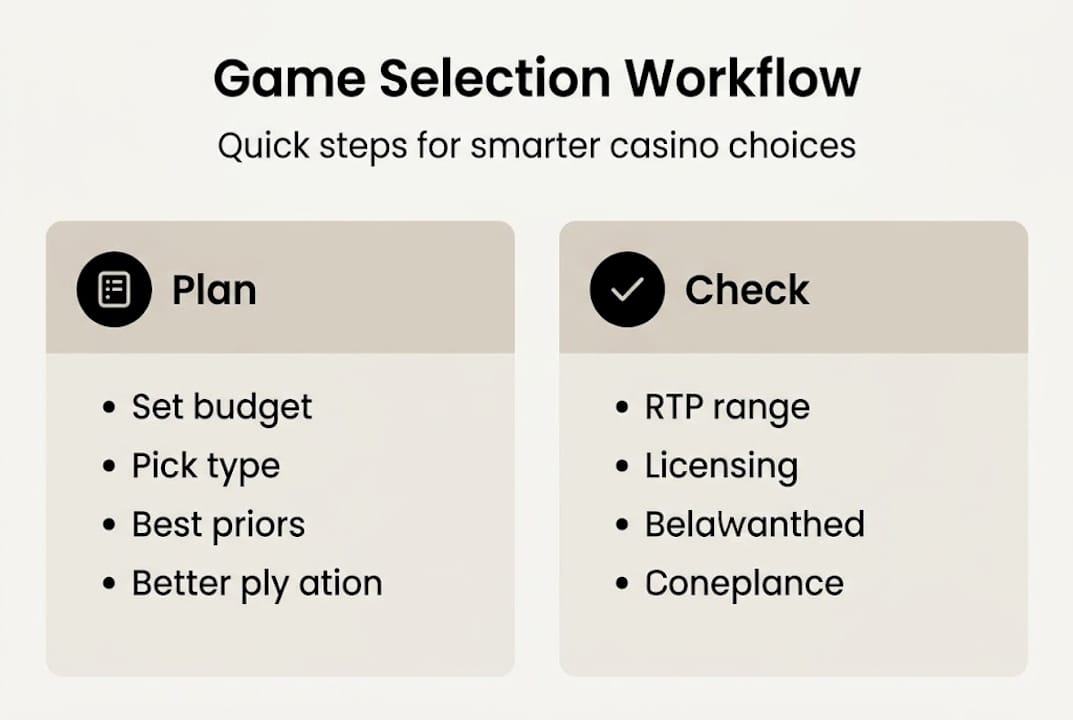
- Step-by-step workflow: How to select the right casino game
- Common pitfalls and advanced tips for 2025
- Best practices and expected results for UK players
- Why most players ignore workflow—and what actually works
- Ready to upgrade your casino game selection?
- Frequently asked questions
Key Takeaways
| Point | Details |
|---|---|
| Match game to your style | Choosing games that suit your risk level and play preferences leads to longer, more enjoyable sessions. |
| Understand RTP and volatility | Evaluating both RTP and volatility gives you a truer picture of game risk and reward. |
| Demo and verify first | Test games with demo play and always check real RTP and licensing before spending money. |
| Beware variable RTP slots | Actual RTP may differ from advertised, so check in-game to avoid surprises in 2025. |
Understand your player profile and preferences
Let’s start by looking at the most important factor: the type of player you are. Before you ever look at a game title or bonus feature, you need an honest picture of your own habits and goals. This single step shapes every decision that follows in your workflow.
Player types broadly fall into a few categories:
- Beginner: Wants simple rules, steady action, and low financial pressure.
- Casual spinner: Plays for entertainment, values fun features over big wins.
- Experienced player: Comfortable with risk, may prefer skill-based games like blackjack or poker.
- High-roller: Larger budgets, willing to absorb variance for the chance of significant payouts.
Once you know where you sit, you can connect your preferences to two critical game metrics: RTP (return to player, the percentage of wagered money a game pays back over time) and volatility (how often and how much a game pays out). New players prefer low-volatility slots for steady sessions, while experienced players favour high-volatility slots or skill games like blackjack.
Session length also matters. If you have 20 minutes and £20, a high-volatility slot could wipe your budget before the fun begins. Low-volatility games stretch your bankroll across more spins, giving you more play time per pound. Our slot volatility guide breaks down exactly how this works in practice, and browsing slot game examples helps you see how different titles compare side by side.
Pro Tip: Write down your session budget and target play time before opening the casino lobby. This simple habit forces you to match your game choice to your actual goals rather than impulse.
Essential criteria: RTP, volatility, and provider licensing
Now that you know your player type, learn how to use game metrics and credentials to shortlist suitable options. Three criteria form the backbone of any solid selection workflow: RTP, volatility, and licensing.
RTP tells you the theoretical long-term return. A UK game selection workflow centres on evaluating RTP in the 94 to 98% range, with table games like blackjack often sitting at the higher end and some slots dipping below 95%. Higher RTP is generally preferable, but it is not the whole story.

| Game type | Typical RTP range | Volatility level | Best suited to |
|---|---|---|---|
| Video slots | 94 to 97% | Low to high | All player types |
| Blackjack | 99%+ | Low | Experienced players |
| Roulette | 94 to 97% | Medium | Casual to experienced |
| Live dealer games | 95 to 99% | Low to medium | Casual to experienced |
| Progressive jackpots | 88 to 94% | Very high | High-rollers |
Volatility is where most players go wrong. Low volatility means frequent but smaller wins. High volatility means rare but potentially large wins. The UKGC emphasises transparency on RTP and volatility so players can make genuinely informed choices. Always look for this information in the game’s paytable or info screen before you stake real money.
“Understanding volatility is just as important as knowing the RTP. A 97% RTP slot with extreme variance can drain a modest bankroll faster than a 94% RTP game with low variance.”
Licensing is non-negotiable. Only play games from providers holding a valid UK Gambling Commission licence. This guarantees fair play, tested RNG (random number generator) outcomes, and recourse if something goes wrong. Check the footer of the casino site and the game’s info panel for licence details. Our guide on understanding casino RTP explains how to read these figures accurately.
Key things to verify before playing:
- RTP is displayed in-game, not just on the casino’s marketing page
- Volatility level is clearly labelled (low, medium, or high)
- The provider holds a current UKGC licence
- The game version matches the advertised RTP
Step-by-step workflow: How to select the right casino game
With the criteria in hand, it’s time to put the workflow into practice. Follow these steps every time you approach a new game or revisit your regular choices.
- Define your session parameters. Set your budget, target session length, and acceptable loss limit before logging in.
- Filter by game type. Use the casino lobby’s filter tools to narrow down by category (slots, table games, live dealer).
- Check RTP and volatility. Open the game’s info screen and confirm both figures. Always demo test, check in-game RTP, and align with your playstyle before committing real money.
- Verify provider licensing. Confirm the developer holds a valid UKGC licence.
- Play the demo version. Most UK casinos offer free play. Use it to assess the game’s pace, features, and feel.
- Evaluate features and bonus rounds. Do the bonus mechanics suit your style? Some players love complex free-spin rounds; others prefer straightforward gameplay.
- Make your final decision. Only move to real-money play once you feel comfortable with the game’s rhythm.
| Workflow step | What to check | Time needed |
|---|---|---|
| Session setup | Budget and loss limit | 2 minutes |
| Game filtering | Category and provider | 3 minutes |
| Metric verification | RTP and volatility | 2 minutes |
| Demo play | Feel and pace | 5 to 10 minutes |
| Final selection | Comfort and enjoyment | 1 minute |
Pro Tip: Browse leading slot games to build a shortlist before your session. Having three or four pre-vetted options saves time and reduces the temptation to pick randomly.
The best UK casino games in 2025 span a wide range of styles and providers, so this workflow applies whether you are picking a five-reel slot or a live blackjack table.
Common pitfalls and advanced tips for 2025
Even with a proven workflow, some stumbling blocks are common. Here’s how to avoid them.
The biggest mistake players make is treating RTP as the only metric that matters. RTP alone can be misleading; volatility and bankroll need to match, and variable RTP slots require in-game checking. A game advertised at 97% RTP might actually run at 94% on the setting your casino has selected.
Common pitfalls to watch for:
- Ignoring variable RTP settings. Some slots allow casinos to adjust the RTP within a permitted range. Always check the in-game paytable, not the provider’s marketing materials.
- Underestimating bankroll requirements for high-volatility games. These titles can go 50 or more spins without a significant win. If your budget cannot absorb that, choose a lower-volatility option.
- Skipping demo play. Even if the metrics look perfect, a game’s pace or visual style might not suit you. Five minutes in demo mode saves real money.
- Overlooking UKGC volatility guidance. The regulator publishes clear expectations around how risk is communicated. If a casino does not display this information, that is a red flag.
- Chasing losses by switching to higher-volatility games. This is the most dangerous pattern in game selection. Stick to your pre-set workflow.
“The players who enjoy online casinos most consistently are those who match their game choice to their actual bankroll, not to their aspirational bankroll.”
For advanced players, consider tracking your results by game type over several sessions. Patterns emerge quickly, and you may find that certain volatility levels consistently suit your style better than others. Our slot volatility tips page covers this in more detail.
Pro Tip: Start new game types at the minimum stake. Even if you normally play at higher levels, a lower stake during the learning phase protects your bankroll while you assess whether the game fits your workflow.
Best practices and expected results for UK players
With pitfalls avoided, what can you realistically expect from following this workflow? The honest answer is: better control, more enjoyment, and fewer unpleasant surprises.
Slots dominate UK play at 65% of all casino activity, with average sessions lasting around 17 minutes. High RTP games above 97% exist but require savvy selection to find and access. This tells us that most UK players are already gravitating towards slots, but many are not applying any structured approach to which slots they choose.
Expected outcomes when you follow the workflow consistently:
- Extended play time. Matching volatility to your budget means your bankroll lasts longer on average.
- Reduced frustration. Knowing what to expect from a game’s variance removes the shock of a dry spell.
- Smarter bonus use. Understanding RTP helps you evaluate whether a welcome offer or free spins deal is genuinely valuable.
- More informed responsible gambling. Setting limits before play, rather than during, is a core principle of safe gambling in the UK.
- Better game discovery. A structured approach leads you to titles you might never have found by browsing randomly.
For better slot selection and to benchmark your choices against industry standards, reviewing casino RTP benchmarks regularly keeps your workflow current as new games and providers enter the market.
Responsible play is not just a regulatory requirement. It is the foundation of a sustainable hobby. Review your game choices periodically, adjust your profile as your experience grows, and never treat a casino session as a source of income.
Why most players ignore workflow—and what actually works
Let’s reflect on why the workflow matters and why most players get it wrong. The honest truth is that high RTP numbers are seductive. A game advertising 98% RTP sounds like it will pay back almost everything you put in. But that figure is calculated over millions of spins, not your 20-minute session.
Most players skip the workflow entirely because they are drawn in by a game’s visual design, a friend’s recommendation, or the promise of a massive jackpot. None of those factors tell you whether the game suits your bankroll or playing style. Experts stress volatility matching over raw RTP, because player experience hinges on session variance, not theoretical long-term averages.
The sessions that players remember fondly are rarely the ones where they chased the highest RTP. They are the ones where the game’s pace, features, and risk level felt right. That alignment only happens when you apply the workflow. Explore slot volatility wisdom to understand why this matters more than any single metric.
Ready to upgrade your casino game selection?
Applying this workflow is far easier when you are working with quality game providers that publish clear RTP and volatility data. That is where Geeky Gambler’s provider reviews come in.

Explore our full breakdown of BGaming casino games to see a provider known for transparent metrics and strong RTP across its catalogue. If you prefer a wider range of styles, our Pragmatic Play slots page covers one of the UK’s most popular providers, with titles spanning every volatility level. Use these reviews as your starting shortlist, apply the workflow steps above, and you will be choosing games with confidence rather than guesswork.
Frequently asked questions
What is the safest way to choose a UK casino game in 2025?
Check for a UKGC-licensed provider, verify RTP and volatility in-game, and demo test before using real money. The UKGC emphasises transparency on RTP and volatility so players can make genuinely informed choices.
How important is RTP compared to volatility?
Both matter, but matching volatility to your bankroll and risk profile often has a bigger impact on your session experience than chasing the highest RTP. Volatility matching over raw RTP shapes player experience far more than theoretical return figures.
Are there games with variable RTP in 2025?
Yes, some slots offer variable RTP settings; always check the in-game or paytable information to see the actual RTP being used. Variable RTP slots require in-game checking as the advertised figure may differ from what is actually applied.
What types of games are best for new casino players?
Low-volatility slots and live dealer games with clear rules offer steadier play for beginners. New players prefer low-volatility slots because they deliver more consistent sessions without large swings in bankroll.

