Affiliate Disclosure: This article contains affiliate links. If you click through and register with one of the casino brands featured, Geeky Gambler may receive a commission. This does not affect our editorial rankings — we only feature operators licensed by the UK Gambling Commission. Gambling can be addictive, please play responsibly. 18+ | BeGambleAware.org
Walking into a casino, you expect more than just flashing lights and big jackpots—you want the confidence that your game is truly fair and your money is protected. For many players, the idea of fair play isn’t simply about lucky streaks but about knowing every spin or deal is genuinely random and free from hidden manipulation. With regulatory bodies like the UK Gambling Commission enforcing strict standards and independent audits, understanding how fairness and compliance work helps you make informed choices, ensuring the gaming experience is transparent and safe.
Table of Contents
- Defining Fair Play In Casinos
- Licensing, Regulation, And Oversight Bodies
- How Casinos Ensure Game Fairness
- Player Rights, Responsibilities And Redress
- Common Pitfalls And How To Avoid Them
Key Takeaways
| Point | Details |
|---|---|
| Fair Play Requirements | Fair play in casinos ensures random outcomes and equal treatment for all players, backed by legal regulation and independent audits. |
| Regulatory Oversight | The UK Gambling Commission enforces strict standards, ensuring that licensed casinos comply with fairness and player protection protocols. |
| Player Rights | Players have clearly defined rights, including access to transparent terms and an independent complaints procedure through Alternative Dispute Resolution (ADR). |
| Avoiding Pitfalls | Players should only engage with licensed casinos and use responsible gambling tools proactively to safeguard their finances. |
Defining Fair Play in Casinos
Fair play in casinos means more than just a marketing phrase. It refers to the commitment that game outcomes are genuinely random, that no hidden controls manipulate results against players, and that every player faces the same odds regardless of their account balance or playing history. Fair play extends to ensuring no party has an unfair advantage, with outcomes being genuine and all participants engaging under equal conditions. When you spin a virtual reel or deal a card online, that result should be generated by verifiable algorithms rather than predetermined decisions made behind the scenes. This distinction matters profoundly because it separates casinos that genuinely operate with integrity from those that merely claim fairness without substance.
Understanding fair play requires recognising two distinct layers that work together. Technical fairness involves the platform’s design and the algorithms generating game results. These systems must produce outcomes that stand alone, with each spin or hand completely independent from the last, free from influence by previous results or player behaviour patterns. However, technical systems alone do not guarantee protection for players. Fair play claims require regulatory backing to guarantee players’ rights, which brings us to legal fairness. This is where regulation enters the picture. Independent bodies like the UK Gambling Commission oversee casinos to verify their technical claims, conduct regular audits, and enforce strict standards. A casino might possess sophisticated randomness algorithms, but without legal oversight and independent verification, those claims remain unverifiable. The combination of solid technical systems plus robust legal safeguards creates genuine fair play protection.
In practice, this means licensed casinos must display their Return to Player (RTP) percentages, publish their terms transparently, and submit to regular testing by certified third-party auditors. These auditors examine whether the games actually perform as advertised, checking that the randomness is genuine and that payout percentages match stated figures. Players benefit from knowing that a regulator actively monitors their chosen casino rather than relying on company promises alone. When you play at a casino licensed by the Gambling Commission, fair play isn’t just a concept—it’s an enforceable requirement backed by law and independent scrutiny.
Here’s a concise comparison of technical and legal fairness in casinos:
| Aspect | Technical Fairness | Legal Fairness |
|---|---|---|
| Main Focus | Random outcomes and independent algorithms | Regulatory oversight and compliance |
| Who Ensures It | Developers, third-party testers | UK Gambling Commission, local authorities |
| How Verified | Game audits, RNG certification | Audits, licence reviews, enforcement |
| Player Protection | Prevents software manipulation | Guarantees legal recourse and rights |
Pro tip: Before depositing any money, verify a casino holds a valid Gambling Commission licence by checking the official register on the Gambling Commission website, which confirms both technical fairness standards and legal oversight are in place.
Licensing, Regulation, and Oversight Bodies
The gambling sector operates under one of the world’s most rigorous regulatory frameworks, with the Gambling Commission sitting at the centre of this oversight. Established under the Gambling Act 2005, this independent body holds the authority to issue operating licences, personal licences, and set binding standards that every casino must follow. Think of the Commission as the referee in a football match—they don’t play the game, but they enforce every rule and ensure all participants follow the same rulebook. The Gambling Commission regulates commercial gambling in Great Britain to ensure casinos operate fairly and safely, whether they’re brick-and-mortar establishments or entirely online platforms. Without a valid Gambling Commission licence, a casino cannot legally operate. This creates a clear dividing line between legitimate operators and unlicensed entities that prey on unsuspecting players.
Going deeper: If you bet on football, our World Cup 2026 hub covers outright odds, group previews and the best sportsbook offers for the tournament.
For the WC-specific operator comparison, see best betting sites for World Cup 2026.
Beyond the Gambling Commission, the regulatory structure involves multiple layers of oversight. The Gambling Commission issues operating and personal licenses required for lawful operation, ensuring casinos meet standards protecting vulnerable players and combating crime. For physical casinos, local licensing authorities issue premises licences that govern day-to-day operations at specific locations. The Commission also establishes Licence Conditions and Codes of Practice, which function as detailed rulebooks defining everything from how casinos must handle customer funds to what records they must maintain. These conditions cover fairness requirements, player protection measures, anti-money laundering protocols, and responsible gambling obligations. Think of it this way: the Gambling Commission sets the overarching standards, and then casinos must prove compliance through regular audits, documentation, and independent testing of their games.
What makes this system effective is collaboration and enforcement. The Commission works alongside law enforcement agencies to prevent fraud, money laundering, and other criminal activity. If a casino violates licence conditions, the Commission can impose fines, suspend operations, or revoke the licence entirely. This enforcement power gives real teeth to regulations rather than leaving them as mere suggestions. Players benefit because they know complaints have somewhere legitimate to go. The Commission maintains a public register showing which casinos hold valid licences, their compliance status, and any enforcement actions taken. For you as a player, this means choosing a Gambling Commission licenced casino isn’t just a preference—it’s accessing a regulated environment where independent bodies actively monitor fairness, protect your money through segregated accounts, and have the authority to take action if something goes wrong.
Pro tip: Check the Gambling Commission’s official register before playing at any casino to confirm it holds a valid licence and review any recent enforcement notices, which take seconds but provide crucial protection.
How Casinos Ensure Game Fairness
At the heart of every legitimate online casino lies a piece of technology called a Random Number Generator (RNG). This software generates completely unpredictable outcomes for every spin, card dealt, or dice roll, ensuring that no player can predict results and no casino can manipulate them. The RNG works milliseconds faster than human perception, constantly generating random sequences even when no one is playing. Online casinos use Random Number Generators to ensure game outcomes are random and unpredictable, maintaining fairness equivalent to traditional brick-and-mortar establishments. However, the existence of an RNG alone doesn’t guarantee fairness. A casino could theoretically claim to have one whilst secretly using manipulated code. This is where independent testing becomes crucial. Reputable testing agencies like eCOGRA and iTech Labs conduct rigorous audits of casino software, verifying that RNGs truly produce random outcomes and that game payout percentages match what the casino advertises. These certifications appear on legitimate casino websites, and you can independently verify them through the testing agencies’ public registers.

Beyond software testing, casinos face stringent regulatory oversight. The Gambling Commission mandates regular audits and controls, including monitoring average drop and win per customer, to prevent manipulation or unfair conduct. These audits examine far more than just code. Regulators analyse player data to spot patterns that might indicate cheating or unfair practices. They review transaction records, scrutinise promotional schemes that could advantage the house unfairly, and verify that casinos actually pay out what they claim. If a casino’s payout rates deviate significantly from their licensed figures, regulators investigate and can impose penalties. The Commission also requires casinos to conduct their own risk assessments, identifying vulnerable customers and potential problem gambling behaviours. This creates multiple checkpoint systems where fairness is monitored continuously rather than just once during initial licensing.
Casinos also build trust through transparency. They publish their Return to Player (RTP) percentages openly, showing exactly what percentage of money wagered should return to players over time. They display RNG certification badges from recognised testing agencies. Many provide detailed explanations of how their games work. When you encounter a licensed casino, you’re not relying on faith—you’re accessing a system with multiple independent oversight layers. The combination of certified software, regulatory monitoring, and transparent reporting creates genuine assurance that the games you’re playing operate fairly. Understanding these mechanisms helps you distinguish between casinos genuinely committed to fairness and those merely making hollow claims.
Pro tip: Before playing at any casino, look for independent RNG certifications from agencies like eCOGRA or iTech Labs displayed on the website, then cross-reference them on the testing agency’s own register to confirm authenticity.
Player Rights, Responsibilities and Redress
When you deposit money at a casino, you gain more than just access to games. You gain explicit legal protections. Players have defined rights including access to clear terms and conditions, and a transparent complaints procedure provided by gambling businesses. This isn’t optional or negotiable. Every Gambling Commission licenced casino must provide you with easily understandable terms explaining how their games work, what fees apply, how withdrawals function, and what happens if disputes arise. You have the right to receive prompt responses when you submit a complaint. You have the right to know exactly how your money is being held and protected. Many players don’t realise they possess these rights, accepting poor treatment or slow responses because they assume casinos operate without oversight. The truth is far different. Casinos operate under legal obligations to treat you fairly, and those obligations are enforceable.
What happens when a casino fails to honour your rights? This is where Alternative Dispute Resolution (ADR) enters the picture. If you lodge a complaint with a casino and remain unsatisfied with their response, you can escalate the matter to an independent ADR provider free of charge. These providers review both your case and the casino’s position, then issue a binding decision. The casino cannot ignore an ADR ruling. This mechanism exists because the Gambling Commission recognised that not every dispute can be resolved between player and operator alone. An ADR provider acts as neutral arbiter, examining evidence without bias. Recent reforms have strengthened these protections further. Recent reforms to gambling laws introduce mandatory protections such as stake limits, enhanced player checks to identify vulnerability, and a statutory levy on operators to fund addiction treatment services, emphasising operator responsibilities to safeguard players. Operators must now implement measures preventing gambling-related harm. They cannot simply take your money and offer games without considering whether you might be experiencing gambling difficulties.
Your responsibilities matter equally. When you create an account, you must provide accurate information and comply with the casino’s terms. You’re responsible for protecting your password and account access. You must play within your means and set limits that reflect your financial situation. If you experience signs of problem gambling, you have a responsibility to seek help and use the tools casinos provide, such as deposit limits, loss limits, or self-exclusion options. The fairness framework works best when both sides uphold their obligations. Casinos owe you transparency and fair treatment. You owe casinos honest information and responsible play. Understanding this balance helps you navigate the gambling landscape confidently, knowing exactly where you stand legally and what recourse you have if something goes wrong.
Pro tip: Before playing at any casino, save a screenshot of their complaints procedure and the ADR provider they use, then review the ADR provider’s independence and track record to understand your redress options before you need them.
Common Pitfalls and How to Avoid Them
Many players unknowingly walk into avoidable traps when choosing and using online casinos. The first major pitfall is playing at unlicensed casinos simply because they offer flashy promotions or slightly better odds. Unlicensed operators operate outside regulatory oversight, meaning if something goes wrong, you have no recourse. Your money sits in unprotected accounts, your personal data lacks security protocols, and games may be rigged without consequence. The temptation of a generous welcome bonus disappears instantly when you cannot withdraw your winnings. Avoid this entirely by checking the Gambling Commission register before depositing a single penny. Legitimate casinos display their licence number prominently. If you cannot find it or it does not appear in the official register, move on immediately.
Related: For tournament-style sign-up offers, see our free bets for the World Cup 2026 ranked by post-T&Cs value.
Another critical pitfall involves misunderstanding how responsible gambling tools actually work. Players often assume these tools only apply to problem gamblers, so they ignore deposit limits, loss limits, and self-exclusion options. This thinking inverts reality. These tools protect everyone by creating structured boundaries that prevent overspending regardless of how in control you feel. A player experiencing early warning signs of problem gambling rarely recognises it themselves. Failures to recognise and respond to vulnerable customers constitute a significant pitfall in the gambling industry, with effective compliance requiring understanding customer needs and training staff to identify harmful gambling behaviours. For you this means using deposit limits not because you think you have a problem, but because they act as a sensible safeguard. Set a monthly limit representing money you can genuinely afford to lose, then stick to it. Do not simply ignore the tool’s existence thinking it does not apply to you.
Casinos themselves face pitfalls too, and understanding these helps you identify safe operators. Weak compliance systems create risk for the business, which inevitably affects players. Implementing a comprehensive risk-based approach, including customer due diligence and monitoring, is crucial to avoid non-compliance with anti-money laundering laws and ensure operational integrity. Reputable casinos invest heavily in compliance staff, training programmes, and monitoring systems. Dodgy operators skip these expenses, cutting corners on security. You can identify serious casinos by their transparency about responsible gambling resources, prompt customer service responses, and detailed terms and conditions. Casinos treating compliance as a checkbox rather than a commitment typically show signs in how they communicate with players. Trust operators who invest visibly in player safety over those offering irresistible bonuses with questionable terms.
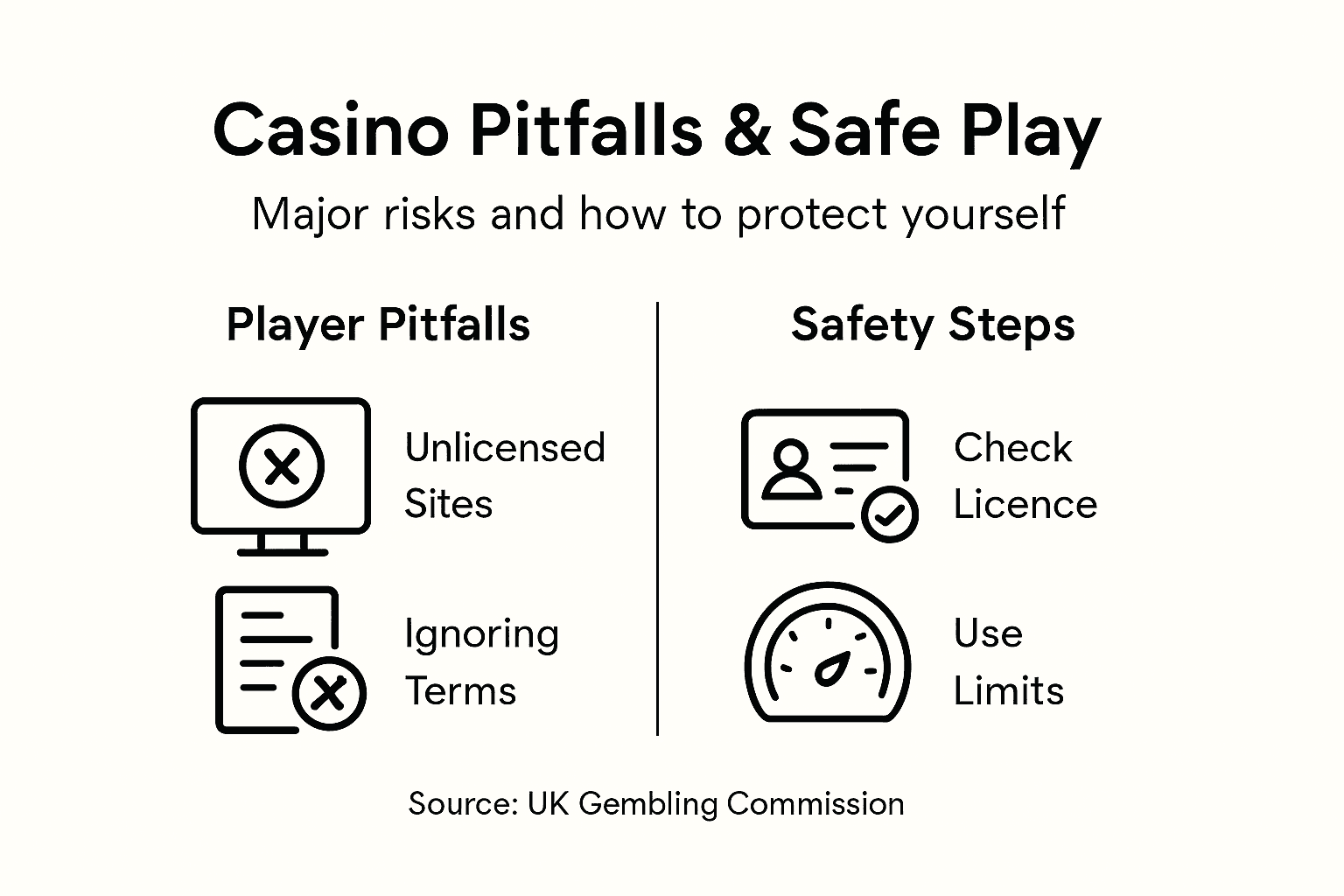
For reference, here are common casino pitfalls and how to steer clear of them:
| Common Pitfall | Risk for Players | How to Avoid |
|---|---|---|
| Playing at unlicensed sites | No legal protection, risk losing funds | Verify licence before depositing |
| Ignoring gambling tools | Overspending and financial harm | Set realistic limits early |
| Choosing opaque operators | Unclear terms and withdrawal problems | Prefer transparent websites |
Pro tip: Set a monthly gambling budget using a deposit limit on your first visit, then treat that limit as absolute rather than something to override when you feel lucky, since discipline matters more than luck in protecting your finances.
Protect Your Play with Trusted Casinos Reviewed by Geeky Gambler
Navigating fairness and legal protections in casinos can be confusing. This article highlights critical challenges such as verifying genuine RNG randomness, confirming valid Gambling Commission licences, and understanding your player rights under strict regulations. These concerns are vital because without trusted verification, you risk losing money to unlicensed or opaque operators who ignore fair play principles. Geeky Gambler is here to simplify that journey for you by providing independent, detailed reviews that focus on fairness, licence authenticity, and transparency. We prioritise casinos that uphold the technical and legal safeguards outlined in the article including verified RNG certifications and adherence to responsible gambling mandates.

Choose from licensed casinos with confidence by exploring our curated list of reliable operators, each assessed for security, game fairness, and payment options. Visit Geeky Gambler now to claim exclusive bonuses and access expert guidance on safely enjoying your favourite games. Don’t risk your stakes with unverified sites. Empower yourself with knowledge, protect your rights, and start your fair play experience today by visiting our platform to find the best verified casinos.
Frequently Asked Questions
What is fair play in casinos?
Fair play in casinos refers to the assurance that game outcomes are genuinely random and not manipulated by the casino. It ensures all players face the same odds, providing a level playing field.
How do casinos ensure game fairness?
Casinos ensure game fairness through the use of Random Number Generators (RNGs) for unpredictability, independent testing agencies for software verification, and strict regulatory oversight by bodies like the Gambling Commission.
What are my rights as a player in a casino?
As a player, you have the right to clear terms and conditions, timely responses to complaints, and to know how your funds are protected. You can escalate unresolved complaints to an independent Alternative Dispute Resolution provider.
How can I identify a reputable casino?
You can identify a reputable casino by checking for a valid licence from the Gambling Commission, reviewing their transparency in publishing Return to Player (RTP) percentages, and ensuring they display certifications from independent testing agencies.