

SSL Encryption in Casinos – Securing UK Players Online
Placing a bet online should feel as safe as locking money in your own wallet. Yet every time you share details with a casino, your data crosses the internet and is at risk if not protected. For UK players who value both fun and financial security, understanding SSL encryption is vital. This guide breaks down how industry-standard protocols like Secure Socket Layer and its modern successor Transport Layer Security shield your personal and payment information—giving you the confidence to choose trustworthy casino sites and offers.
Table of Contents
- SSL Encryption Explained For UK Casinos
- How SSL Protects Player Data And Funds
- Types Of SSL Certificates For Casinos
- Licensing, Compliance And Security Standards
- Identifying Safe Casinos Using SSL Encryption
Key Takeaways
| Point | Details |
|---|---|
| Importance of SSL Encryption | SSL encryption protects sensitive data, ensuring secure transactions between you and online casinos. |
| Verification of Casino Legitimacy | Always check for the padlock symbol and ‘HTTPS’ in the URL to confirm a casino’s authenticity. |
| Regulatory Compliance | Licensed UK casinos must adhere to stringent security standards, including the use of SSL encryption to protect player data. |
| Recognising Safe Practices | Look for Extended Validation certificates and transparent operational details as indicators of a trustworthy casino. |
SSL Encryption Explained for UK Casinos
When you log into your favourite casino site to check your balance or place a bet, your sensitive data travels across the internet. Without protection, anyone listening in could steal your login details, payment information, or personal data. That’s where Secure Socket Layer (SSL) encryption steps in.
SSL is a cryptographic protocol developed in 1995 to encrypt data and ensure secure communication over networks. It creates a protective tunnel between your browser and the casino’s servers, scrambling your information so only authorised parties can read it. Today’s casinos use its modern successor, Transport Layer Security (TLS), which works on the same core principles but with stronger security.
Here’s what SSL encryption does for you:
- Protects your login credentials from being intercepted
- Encrypts payment and banking details during transactions
- Prevents unauthorised access to your account and personal information
- Ensures messages between you and the casino cannot be altered
- Verifies the casino website is authentic, not a fraudulent copy
How the Encryption Process Works
When you visit a secure casino, SSL/TLS uses cryptographic algorithms and digital certificates to establish a secure connection. The process happens automatically in the background through what’s called a handshake protocol.
Your browser sends an initial request. The casino’s server responds with its digital certificate, proving its identity. Your browser verifies this certificate. If everything checks out, they exchange encryption keys securely. Once complete, all data flowing between you and the casino is encrypted. No one watching your internet connection can decipher it.
This entire exchange takes milliseconds. You won’t notice it happening, but it’s protecting every piece of information you send.
Why This Matters for UK Casino Players
UK online casinos are regulated and must meet strict security standards. SSL/TLS encryption provides strong encryption that safeguards privacy, integrity, and authentication of your data, helping licensed operators comply with these requirements.
When you deposit funds, place bets, or claim bonuses, your financial data is encrypted. When a casino stores your personal details (address, contact information, identity verification documents), that data is also encrypted in their databases.
Licensed casinos display visible indicators that SSL is active:
- A padlock icon in the address bar
- “HTTPS” in the website URL (the “S” means secure)
- No security warnings from your browser
If you visit a casino and don’t see these signs, leave immediately. Your data is at risk.
SSL encryption is non-negotiable for safe gambling online. Every legitimate UK casino uses it because regulators require it and players demand it.
Pro tip: Before logging in or making a deposit, always verify the padlock icon is present and check the URL starts with “https://” rather than just “http://”. This simple habit protects you from phishing scams and fake casino sites.
How SSL Protects Player Data and Funds
Your casino account contains valuable information. Your login credentials, payment methods, personal documents, and account balance are all targets for cybercriminals. SSL encryption acts as a digital vault, protecting everything you send to and receive from the casino.

When SSL is active, data travelling between your device and the casino’s servers becomes unreadable to anyone attempting to intercept it. Hackers can see encrypted data flowing past, but they cannot decipher it. It’s like watching someone send sealed letters through the post—you know something is being transmitted, but you cannot read the contents.
Here’s what SSL specifically protects:
- Your login username and password from being stolen during sign-in
- Bank account details and card information during deposits or withdrawals
- Personal identification documents (passport, driving licence, proof of address)
- Betting history and account transaction records
- Bonus claims and withdrawal requests
Authentication: Proving the Casino Is Real
SSL uses a handshake mechanism to authenticate both client and server, preventing impersonation attacks. This means your browser verifies the casino website is genuinely operated by the licensed operator, not a fraudulent copy.
Without this verification step, scammers could create fake casino sites that look identical to the real thing. You’d enter your credentials, thinking you’re logging in safely. The fake site would capture your information instead.
SSL’s authentication creates a chain of trust. The casino obtains a digital certificate from a trusted authority. Your browser checks this certificate and confirms it’s legitimate.
Data Integrity: Detecting Tampering
TLS guarantees identification, confidentiality, and integrity between client devices and servers, ensuring no third party can tamper with data in transit. Even if someone intercepted your data, they cannot modify it without being detected.
Consider a withdrawal request worth £500. SSL creates a digital signature on that request. If anyone tries to change it to £5,000 during transmission, the signature breaks. The casino’s system detects the tampering and rejects the request.
This protection matters enormously for your funds. Your withdrawal instructions, deposit amounts, and bonus claims all remain exactly as you sent them.
SSL encryption transforms your casino transactions from vulnerable to virtually untraceable. Attackers cannot read, intercept, or modify your data.
Pro tip: Check your account statements regularly and enable two-factor authentication if the casino offers it. Combined with SSL encryption, two-factor protection adds another layer of security that makes unauthorised access nearly impossible.
Types of SSL Certificates for Casinos
Not all SSL certificates are created equal. Casinos use different types depending on their operational structure and the level of trust they want to establish with players. Understanding these differences helps you recognise legitimate, security-conscious operators.
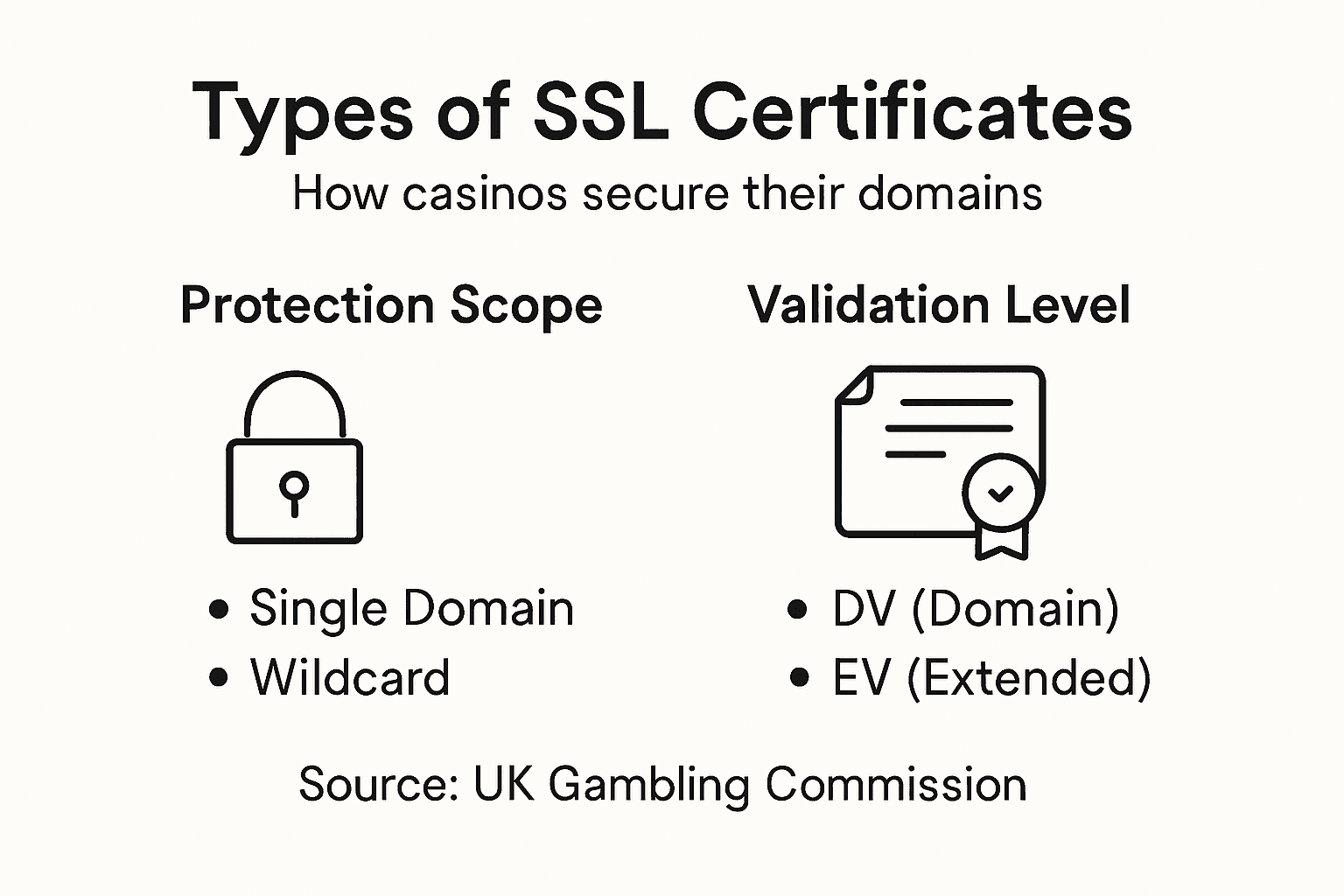
SSL certificates vary in two main ways: the scope of protection (which domains they cover) and the validation level (how thoroughly the issuing authority verifies the operator’s identity). A reputable UK casino invests in the right certificate type to protect both your data and their reputation.
Coverage Types: Which Domains Are Protected
Different casinos have different website structures. Some operate a single domain. Others run multiple brands or have subdomains for mobile apps and live dealer games.
Single-domain certificates protect one specific domain only. A casino using this certificate secures www.examplecasino.co.uk but not any subdomains.
Wildcard certificates secure a domain and all its subdomains with one certificate. This works well for casinos offering casino.example.co.uk, sports.example.co.uk, and poker.example.co.uk from the same organisation.
Multi-domain certificates secure multiple unrelated domains under a single certificate. Larger gaming operators managing several casino brands use this approach for efficiency.
Validation Levels: Trust and Assurance
This is where the real distinction emerges. Domain Validated, Organisation Validated, and Extended Validation certificates differ by the level and type of identity verification performed, with each level providing increasing assurance about the operator’s legitimacy.
Domain Validated (DV) certificates verify only that someone controls the domain. The issuing authority sends a verification email to the domain owner. DV certificates are quick and affordable, but they don’t confirm the operator’s true identity.
Organisation Validated (OV) certificates require the issuing authority to verify the actual business operating the casino. They confirm the company’s legal registration, address, and contact information. OV certificates carry more weight than DV certificates.
Extended Validation (EV) certificates represent the highest standard. The issuing authority conducts thorough verification of the operator’s identity, legal status, and financial stability. When you visit a casino with an EV certificate, your browser displays a green padlock or security indicator with the company name. This visible trust signal matters enormously.
Licensed UK casinos typically use OV or EV certificates because regulators expect operators to prove their legitimacy. If a casino displays only a basic DV certificate, that’s a red flag.
Here’s how SSL certificate types differ for online casinos:
| Certificate Type | Validation Process | Suitable For | Typical Browser Indicator |
|---|---|---|---|
| Domain Validated (DV) | Email confirmation to domain owner | Small, low-risk sites | Basic padlock symbol |
| Organisation Validated (OV) | Business legitimacy is verified | Regulated UK casinos | Padlock with no company name |
| Extended Validation (EV) | Full legal and financial checks | High-trust, large casinos | Padlock with company name |
Extended Validation certificates provide the highest identity assurance, which is critical for online casinos to instil trust about authenticity and security.
Pro tip: Click the padlock icon in your browser’s address bar before logging in. It shows you the certificate type and organisation name. A reputable casino’s certificate displays a recognisable company name and validation level, not generic placeholder text.
Licensing, Compliance and Security Standards
SSL encryption protects your data in transit, but it’s only one layer of security. Behind every legitimate UK casino sits a framework of licensing, compliance requirements, and security standards designed to protect players and maintain operational integrity.
UK casinos don’t operate freely. They must obtain licences from the Gambling Commission and comply with strict regulations. These requirements exist specifically to safeguard your money, personal information, and fair gaming experience.
Regulatory Requirements and Licensing
Licensing authorities set security governance standards within casinos that operators must follow to maintain their operating permits. The Gambling Commission verifies that casinos have implemented proper security controls before granting licences.
Licensed operators must demonstrate they have:
- Secure systems protecting player data and funds
- Procedures for verifying player identity
- Controls preventing underage gambling
- Responsible gambling tools and protections
- Fair game algorithms and regular audits
When you register at a licensed casino, the operator verifies your identity to comply with these requirements. It might feel invasive, but it’s a mandatory protection for you and the industry.
Anti-Money Laundering and Compliance Standards
Casinos implement comprehensive compliance programmes including player identity verification and transaction monitoring to meet international Anti-Money Laundering (AML) standards. These controls prevent criminals from using casinos to hide illicit funds.
You’ll notice casinos ask for proof of identity, address, and sometimes source of funds. They monitor your account for suspicious patterns. If your betting suddenly spikes dramatically or transactions appear unusual, the casino investigates.
This sounds like surveillance, but it protects you. It prevents account takeovers and fraud. Legitimate casinos embrace these requirements because they build trust.
SSL as Part of Broader Security
SSL encryption works alongside these compliance standards. Together, they create comprehensive protection:
- SSL encrypts your data in transit
- Licensing ensures operators meet minimum security standards
- Compliance monitoring detects fraudulent activity
- Audit processes verify systems actually work as promised
A casino with a valid licence, proper SSL encryption, and active compliance programmes represents genuine commitment to player safety.
The table below outlines how SSL, licensing, and compliance work together to protect UK casino players:
| Protection Layer | Purpose | Example of Player Benefit |
|---|---|---|
| SSL Encryption | Secures data in transit | Prevents stolen payment details |
| Gambling Licence | Ensures regulatory oversight | Verifies operator legitimacy |
| Compliance Programmes | Detects suspicious activity | Stops fraud and money laundering |
Licensing and compliance standards transform SSL encryption from a technical feature into a promise backed by regulatory oversight and penalties for failure.
Pro tip: Verify the casino’s Gambling Commission licence on the official register before depositing. You can check their actual licence status, authorised activities, and any enforcement actions taken against them—this single step eliminates virtually all fraudulent operators.
Identifying Safe Casinos Using SSL Encryption
You’ve learned how SSL encryption works and what it protects. Now comes the practical question: how do you spot a safe casino before you deposit your money?
SSL encryption is your first visual clue. It’s not foolproof on its own, but combined with other security indicators, it forms a reliable safety checklist. A legitimate casino displays SSL encryption visibly and backs it up with proper licensing and compliance.
The Visual SSL Indicators
Before entering any personal information or payment details, check these three things:
The padlock symbol appears in your browser’s address bar. Click it and you’ll see certificate details confirming the connection is encrypted. If the padlock is missing or shows a warning, leave immediately.
HTTPS in the URL means the page uses encrypted communication. Compare “https://casino.co.uk” (secure) versus “http://casino.co.uk” (not secure). The extra “S” represents security.
No browser warnings should appear. Modern browsers flag insecure or fraudulent certificates immediately. If your browser displays a warning about the site’s security, trust it and navigate away.
To identify safe casinos, users should check for HTTPS and the padlock symbol in the browser, which indicate encrypted communication. These visual markers exist specifically to help you verify security before trusting a website with your information.
Beyond SSL: The Complete Safety Checklist
SSL encryption alone doesn’t guarantee safety. Scammers can sometimes obtain SSL certificates too. You need additional verification:
- The casino holds a valid Gambling Commission licence
- Their certificate shows an Extended Validation level (company name visible)
- The website includes clear contact details and physical address
- They display responsible gambling tools (deposit limits, self-exclusion options)
- Customer reviews mention reliable payouts and responsive support
- They’re listed in the Gambling Commission’s public register
When all these factors align—SSL encryption, proper licensing, transparent operations, and positive player feedback—you’re dealing with a legitimate operator.
Red Flags to Avoid
Certain combinations of missing security elements should alarm you instantly:
- HTTP instead of HTTPS
- Missing padlock symbol or certificate warnings
- No visible licensing information
- Difficulty finding contact details
- Promises of guaranteed wins or unrealistic bonuses
- Poor or obviously fake customer reviews
One missing element might be innocent. Multiple missing elements together? That’s a clear danger signal.
SSL encryption is your first defence, but licensing verification and operator transparency complete the picture of a safe casino.
Pro tip: Before visiting any casino site, search “[casino name] + scam” or “[casino name] + Gambling Commission” on Google. Legitimate casinos appear in official registers and licensing databases. Fraudulent ones generate complaint forums and warnings instead.
Stay Secure and Confident with Trusted UK Casinos at Geeky Gambler
Protecting your data with SSL encryption is crucial when playing at online casinos in the UK. You deserve more than just promises of security — you need transparent, licensed operators who have proven their commitment through strong encryption, proper licensing, and compliance. At Geeky Gambler, we understand how important it is to spot safe casinos that prioritise your privacy and funds, ensuring you never have to worry about unauthorised access or scams.

Explore our expertly reviewed selection of UK casinos where SSL encryption and extended validation certificates are standard. We provide detailed insights on security measures, licensing verification, and how casinos comply with Gambling Commission regulations. Don’t take chances with your personal data or money. Visit Geeky Gambler now to find your next secure and trustworthy casino. Learn more about how SSL protects your gameplay at Geeky Gambler and make informed, safe deposits today.
Frequently Asked Questions
What is SSL encryption and how does it work in online casinos?
SSL encryption is a cryptographic protocol that creates a secure connection between your browser and the casino’s server. It encrypts your data, ensuring that sensitive information like login details and payment information cannot be intercepted by unauthorised parties.
Why is SSL encryption important for online gambling?
SSL encryption is crucial for online gambling as it protects players’ sensitive data during transactions, prevents unauthorised access to accounts, and verifies the authenticity of the casino’s website, thereby safeguarding players from fraud.
How can I verify if an online casino is using SSL encryption?
You can verify SSL encryption by checking for a padlock symbol in the address bar and ensuring that the website URL begins with “https://”. If these indicators are absent, the site may not be secure.
What types of SSL certificates are used by online casinos?
Casinos typically use three types of SSL certificates: Domain Validated (DV), Organisation Validated (OV), and Extended Validation (EV). Each type differs in the level of verification and assurance provided regarding the casino’s legitimacy, with EV certificates offering the highest level of trust.


