

Remote gaming duty UK casinos: your clear guide
TL;DR:
- Remote Gaming Duty is a UK tax paid by online casino operators, not players, influencing game promotions and market structure. The duty rate will nearly double from 21% to 40% in April 2026, prompting operators to adjust their offerings and marketing strategies. Compliance involves accurate geolocation, financial tracking, and aligning regulatory and tax reporting to protect players and ensure lawful operation.
If you play at UK online casinos, you have probably never seen a line on your account statement reading “Remote Gaming Duty.” That is because what is remote gaming duty in a UK casino context is a tax that operators pay, not you. Yet this charge shapes almost everything about how those casinos operate, what games they push, and how they structure their bonuses. With a major rate change landing in April 2026, understanding how this duty works is no longer just useful knowledge for accountants. It matters to every UK player who wants to understand why the online casino landscape is shifting.
Table of Contents
- What is remote gaming duty and how does it work
- Recent changes to remote gaming duty rates and what they mean
- How remote gaming duty differs from other gambling duties in the UK
- Operational and compliance implications of remote gaming duty for UK operators
- What remote gaming duty means for UK players and the online casino market
- A fresh perspective on the impact of remote gaming duty in the UK casino sector
- Finding safe UK online casinos and bonuses compliant with remote gaming duty
- Frequently asked questions
Key Takeaways
| Point | Details |
|---|---|
| Remote Gaming Duty | It is a tax on online casino operators’ profits from UK players, not a charge paid directly by players. |
| 2026 rate increase | Remote Gaming Duty rate rises sharply from 21% to 40% starting April 2026 for accounting periods. |
| Duty differentiation | Remote gaming is taxed higher than remote betting due to different harm and cost profiles. |
| Compliance importance | Operators must accurately report profits and verify UK player location to meet duty rules. |
| Player impact indirect | Players feel effects through operator adjustments, not a direct tax on bets or winnings. |
What is remote gaming duty and how does it work
Remote Gaming Duty (RGD) is a government excise tax levied on the profits that online casino operators generate from UK customers. Think of it as a cost of doing business in the UK market, applied to the operator’s gross gaming profit rather than individual bets or winnings. Remote Gaming Duty is an excise duty on remote gaming profits under the Finance Act 2014, Part 3, Chapter 3.
The key distinction players often miss: you do not pay this tax. It never touches your deposit, your winnings, or your free spins balance. The casino absorbs it as a business expense, much like any other commercial enterprise pays corporation tax or VAT on its operations.
What makes RGD particularly significant is the place of consumption principle. An operator based in Gibraltar, Malta, or anywhere else in the world still owes UK Remote Gaming Duty if their customers are UK residents. Location of the casino’s servers or headquarters is irrelevant. If the player is in the UK, the duty applies. This principle was a landmark shift when introduced, closing the offshore loophole that operators had previously exploited by basing themselves abroad.
Here is what the duty covers in practice:
- Online casino games including slots, roulette, blackjack, and baccarat
- Live dealer casino products streamed to UK players
- Poker games operated on a remote basis
- Any other remote gaming activity as defined under UK gambling law
It does not cover remote betting (such as sports wagering) or lottery products, which fall under separate duty regimes. Understanding that separation matters when comparing tax rates across different product types, as we will cover shortly. For a broader view of how UK gambling laws protect players, the regulatory framework extends well beyond just tax compliance.
Recent changes to remote gaming duty rates and what they mean
Here is where it gets serious for the industry. From 1 April 2026, Remote Gaming Duty rises from 21% to 40%. That is nearly double the previous rate, representing one of the most significant tax changes to hit the UK online casino sector in years.
The government’s rationale is harm reduction. Online slots and casino games carry a higher association with problem gambling than sports betting, and the duty increase is designed to reduce the commercial incentive for operators to heavily promote these products. Put simply, if the profit margin on a slot machine is taxed more heavily, operators have less reason to advertise it aggressively.
For operators, managing this transition requires genuine operational precision. Here is why:
- Accounting periods that start before 1 April 2026 use the old 21% rate for profits earned up to that point.
- Accounting periods starting on or after 1 April 2026 use the new 40% rate from day one.
- Periods that span the changeover date require split calculations, applying each rate to the relevant portion of profits.
- Financial systems need updating to handle this split accurately, since HMRC will expect correctly apportioned figures with no rounding shortcuts.
“The rate increase reflects the government’s view that remote gaming products carry higher harm potential and should bear a heavier fiscal burden relative to lower-risk gambling forms.”
Pro Tip: If you are evaluating a UK online casino’s financial stability ahead of the 2026 changes, look for operators that have already updated their regulatory filings and published transparent terms. Operators scrambling to absorb a near-doubling of their tax liability on casino profits may start cutting player bonuses or reducing game variety to protect margins. Stay informed about UK online casino changes in 2026 to spot how operators are adapting.
How remote gaming duty differs from other gambling duties in the UK
Not all UK gambling taxes are created equal. Remote gaming duty sits alongside remote betting duty and general betting duty, but the rates and rationale differ substantially. Understanding this distinction explains a lot about the current UK gambling landscape.
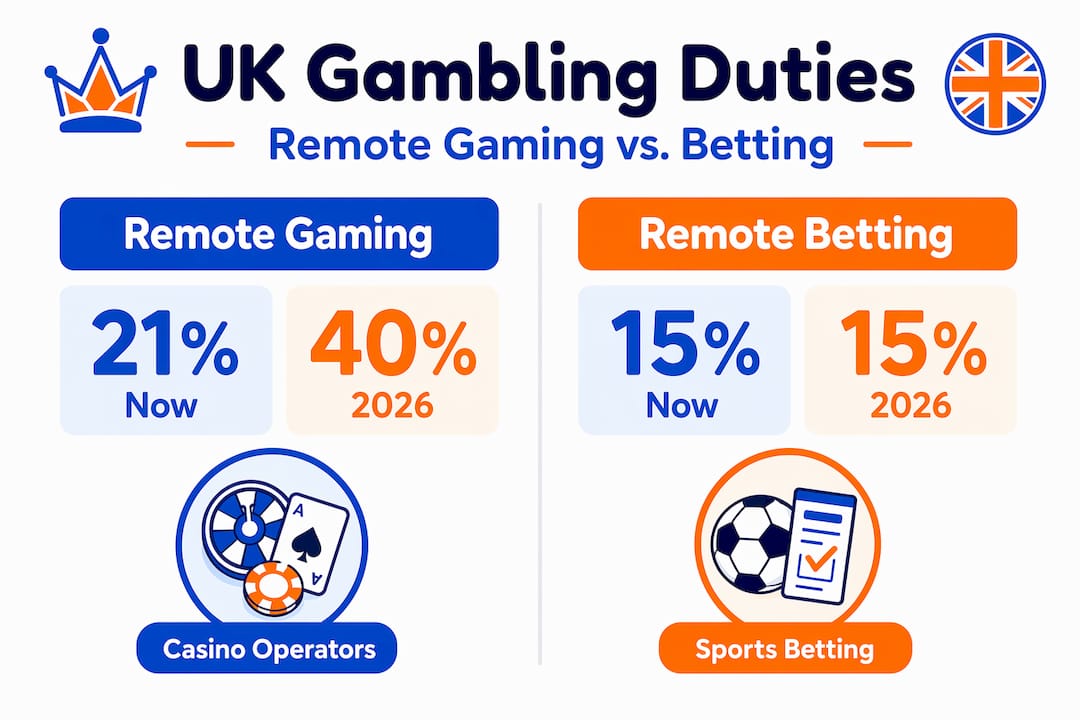
| Duty type | Current rate | Rate from April 2026/2027 | Applies to |
|---|---|---|---|
| Remote Gaming Duty | 21% | 40% (April 2026) | Online casino games, slots, live dealer |
| Remote Betting Duty | 15% | 25% (April 2027) | Remote sports betting, fixed odds |
| General Betting Duty | 15% | Unchanged initially | Land-based betting shops |
Remote betting and gaming are taxed differently due to their distinct characteristics and harm levels. During the government’s consultation, stakeholders from both sides of the industry argued that remote gaming carries higher harm risk and lower operational cost per unit of profit, justifying the elevated rate.
Why does the cost structure matter? Betting operators face significant trading costs: they need to price markets, manage liability, and respond to sharp bettors. Casino operators running slots, by contrast, run products with predictable, mathematically fixed margins. The government views this as a more easily taxable revenue stream with fewer grounds for relief.
Key points that define the distinction:
- Remote gaming is associated with faster, more repetitive play patterns linked to higher harm
- The tax differential is intentional policy, not administrative oversight
- The gap between gaming (40%) and betting (25%) rates signals where regulators want operators to shift their focus
- The UK gambling industry trends show operators increasingly diversifying into sports betting partly in response to this regulatory pressure
Operational and compliance implications of remote gaming duty for UK operators
Paying the duty is only part of the challenge. Compliance with Remote Gaming Duty involves a chain of interconnected obligations that touch every corner of an operator’s technology and finance functions.
The core of the system is Gross Gambling Yield (GGY), which equals stakes received minus winnings paid. This is the taxable base. Operators align tax calculation with the Gambling Commission’s regulatory returns using GGY concepts, meaning the numbers submitted to HMRC for duty purposes should reconcile with the figures filed with the regulator. Discrepancies between the two create reconciliation risk and can trigger audits.
Here is what robust compliance looks like in practice:
- Geolocation controls: Operators must confirm that customers are UK residents, not simply users who registered with a UK address. IP verification, card issuer country, and document checks all play a role.
- Split accounting for 2026: Finance teams need software capable of applying different duty rates to the same accounting period, with a hard cutoff at 1 April 2026.
- Real-time GGY tracking: Duty is calculated on profits as they accrue, requiring live financial data rather than periodic estimates.
- Regulatory and tax filing consistency: The Gambling Commission and HMRC both receive data that must match. Any divergence between regulatory returns and tax filings raises questions.
| Compliance area | Key requirement | Risk if missed |
|---|---|---|
| Customer identification | Geolocation and ID checks | Tax applied to non-UK profits |
| GGY calculation | Gross stakes minus payouts | Incorrect duty liability |
| Split period accounting | Rate split at 1 April 2026 | Under or overpayment |
| Regulatory alignment | Match Gambling Commission returns | Audit trigger |
Pro Tip: As a player, the practical indicator of a well-compliant operator is a valid UK Gambling Commission licence clearly displayed in the site footer. Operators holding that online casino licence are already subject to regulatory return obligations that feed directly into duty compliance.
What remote gaming duty means for UK players and the online casino market
Let us be direct: you will not see this tax on any screen at your casino. But its effects are absolutely present in your playing experience, and they are about to become more pronounced as the 40% rate takes hold.

Remote gaming duty is a business cost borne by operators, not a direct player payment. Operators face this tax exposure regardless of their location if they are serving UK customers. When you hear that the Office for Budget Responsibility tracks this as a meaningful revenue stream, it gives you a sense of the scale: UK online casino gaming generates substantial taxable profits each year.
What this means for you in practical terms:
- Bonus changes: Operators absorbing higher tax costs may reduce welcome bonus values, free spin quantities, or wagering requirements that were previously more generous.
- Game availability: Higher-harm slots may be deprioritised in lobbies or removed from promotional pushes, while lower-margin table games could be promoted more heavily.
- Pricing of live dealer games: With more complex cost structures, some live casino tables may see reduced bet limits as operators manage exposure.
- Safer play features: The same tax logic that taxes harmful products more heavily also incentivises operators to invest in responsible remote gaming tools as a way to demonstrate harm-reduction commitment.
The indirect effect on the market is a gradual shift away from volume-based slot promotion towards a model where operators compete on quality, trust, and game variety rather than sheer marketing intensity.
A fresh perspective on the impact of remote gaming duty in the UK casino sector
There is a version of this story told in press releases: the government raises taxes to protect players, operators adapt, everyone benefits. The reality is messier and more interesting.
The place of consumption basis ensures tax follows UK customers, reducing offshore avoidance risks but raising compliance complexity. That last part often gets buried. Every non-UK operator now needs infrastructure capable of accurately identifying UK players, splitting their revenue, and filing correctly with HMRC. For large, well-capitalised operators, this is a manageable cost. For smaller or newer operators, it is a genuine barrier that could push them toward non-compliant workarounds or exit from the UK market entirely.
That is not necessarily a bad outcome. Market concentration among compliant, well-regulated operators may actually improve player protection overall. But it does raise a legitimate question about whether very high tax rates create a shadow market where unlicensed sites hoover up players who find fewer options in the regulated space.
The duty increase also does something subtle to the relationship between operators and the Gambling Commission. Both tax compliance and regulatory compliance rely on the same GGY data, which means operators have a financial incentive to be accurate in their reporting rather than gaming the numbers. That alignment is genuinely clever policy design, and it is often overlooked in commentary focused purely on the rate headline. The UKGC’s 100 safety actions for 2026 sit within this broader picture of tightening oversight across both financial and consumer protection dimensions.
Our view at Geeky Gambler: the 40% rate is the right direction, but its effectiveness depends entirely on enforcement quality. A high tax rate on compliant operators means nothing if unlicensed alternatives operate freely. The duty increase and the regulatory framework only protect players if they are applied consistently.
Finding safe UK online casinos and bonuses compliant with remote gaming duty
Now that you understand how Remote Gaming Duty shapes the UK online casino market, you can use that knowledge to make sharper choices about where you play.

At Geeky Gambler, every casino we review holds a valid UK Gambling Commission licence, meaning they already operate within the duty and compliance framework discussed above. We check licensing status, financial transparency, and responsible gambling tools before recommending any site. Browse our best online casino bonuses to find welcome offers, free spins, and match deals from operators who have passed our compliance checks. For a full breakdown of which UK casinos meet the highest standards in 2026, explore our UK casino reviews and make your next deposit with confidence.
Frequently asked questions
Who pays remote gaming duty in the UK?
Remote gaming duty is a business cost borne by operators rather than a separate duty you personally pay. The casino handles this as a trading expense.
When does the new 40% remote gaming duty rate take effect?
The rate increases from 21% to 40% from 1 April 2026 for accounting periods starting on or after that date, with split calculations required for periods spanning the changeover.
Does remote gaming duty affect UK players’ bets or winnings?
No. Remote gaming duty taxes the operator’s profits, not players at checkout. Your winnings and deposits are unaffected by this tax.
Why is remote gaming duty higher than remote betting duty?
Remote betting and gaming are taxed differently due to distinct levels of harm and costs, with casino-style gaming carrying higher harm risk and warranting the heavier rate.
How do operators determine which customers are UK residents for duty purposes?
Operators use geolocation tools, card issuer data, and identity verification to confirm customer location, ensuring duty applies only on profits generated from UK persons rather than their wider global player base.

