

Why reading casino T&Cs protects UK players in 2026
TL;DR:
- Reading casino terms reveals important rules on withdrawals, bonuses, and funds protection.
- Key clauses to check include wagering requirements, game restrictions, and fund segregation details.
- Understanding T&Cs helps players avoid missed payouts, capped winnings, and security issues.
Most UK online casino players click “I agree” without reading a single line of the terms and conditions. It feels tedious, the text is dense, and the games are just one click away. But that habit is quietly costing players real money. Hidden inside those pages are the rules that govern your withdrawals, protect your deposited funds, and determine whether your bonus winnings are ever actually yours to keep. This article walks you through exactly why casino terms and conditions matter, which clauses deserve your attention, and how understanding them turns you from a passive player into a genuinely informed one.
Table of Contents
- Why terms and conditions matter for UK casino players
- What to check: Key clauses hidden in casino terms
- Understanding bonus terms: Don’t lose your winnings
- How fund protection and security disclosures affect you
- The hidden costs of skipping casino terms: Our perspective
- Find trusted bonuses and safe casinos with Geeky Gambler
- Frequently asked questions
Key Takeaways
| Point | Details |
|---|---|
| Legal protection | Casino terms and conditions define your rights, protections and responsibilities as a player. |
| Bonus transparency | Reading bonus terms ensures you avoid forfeiting winnings due to hidden rules. |
| Fund and data security | UK casinos must disclose how they safeguard your money and personal data. |
| Safer choices | Checking T&Cs before playing helps you pick trustworthy casinos and avoid costly surprises. |
Why terms and conditions matter for UK casino players
Think of a casino’s terms and conditions as the rulebook for every transaction you’ll ever make on that site. They cover everything from how long a withdrawal takes to what happens to your money if the casino goes bust. Skipping them isn’t just risky; it’s like signing a contract without reading it.
For UK players specifically, the legal framework adds extra weight to these documents. Licensed casinos UK operate under strict UK Gambling Commission rules, meaning their T&Cs must meet certain transparency standards. That’s a genuine layer of protection you won’t find at offshore sites.
Here’s what T&Cs typically govern:
- Withdrawal procedures: Minimum amounts, verification requirements, and processing times
- Bonus eligibility: Who qualifies, what triggers the offer, and what voids it
- Account closure: When a casino can suspend or close your account
- Dispute resolution: How complaints are handled and which independent body adjudicates
- Responsible gambling tools: Self-exclusion, deposit limits, and cooling-off periods
One of the most important protections buried in T&Cs relates to your deposited funds. UK Gambling Commission guidance confirms that fund protection levels must be disclosed in T&Cs, with players actively acknowledging them before depositing. This isn’t a formality. It tells you whether your money sits in a segregated account or gets mixed with the casino’s operational funds.
“Not all UK casinos offer the same level of fund protection. The difference between ‘basic’ and ‘high’ protection could mean the difference between recovering your balance or losing it entirely if an operator becomes insolvent.”
For a thorough breakdown of what these documents actually contain, understanding online casino terms is a solid starting point before you register anywhere new. The few minutes you invest in reading the key sections will consistently outperform the minutes you’d otherwise spend chasing a support team about a blocked withdrawal.
What to check: Key clauses hidden in casino terms
Not all clauses carry equal weight. Some sections of a casino’s T&Cs are largely standard legal boilerplate, while others directly affect your money. Knowing which is which saves you time and protects your balance.
The sections that matter most include:
- Wagering requirements: How many times you must bet a bonus before withdrawing
- Game restrictions: Which games count towards clearing a bonus (slots usually do; live casino often doesn’t)
- Bonus expiry dates: The window in which you must use and clear a bonus
- Withdrawal caps: Maximum amounts you can withdraw from bonus winnings
- Verification requirements: What documents are needed and when they’re requested
- Dormant account policy: Fees or closure rules if you stop playing for a set period
Withdrawal policies are particularly worth scrutinising. Some casinos set minimum withdrawal thresholds as high as £20 or £30, which can trap smaller balances. Others require identity verification only at the point of withdrawal, causing delays precisely when you want your money quickly.
Fund segregation details are equally critical. Players must review and acknowledge fund protection arrangements before depositing at any UK-licensed casino. If that section is vague or missing, treat it as a red flag.
For a full guide to interpreting these sections, the casino clauses explained resource breaks them down in plain language. You can also cross-reference with player protections to understand what UK regulations guarantee regardless of what a casino’s T&Cs say.
Pro Tip: Always locate the dispute resolution clause before you play. It tells you which Alternative Dispute Resolution (ADR) provider handles complaints. If a casino doesn’t name one, that’s a serious warning sign under UKGC rules.
Understanding bonus terms: Don’t lose your winnings
Bonuses are the headline act at most UK casinos, but the terms attached to them are where many players come unstuck. A generous-looking welcome offer can quietly become worthless if the conditions attached are unrealistic.
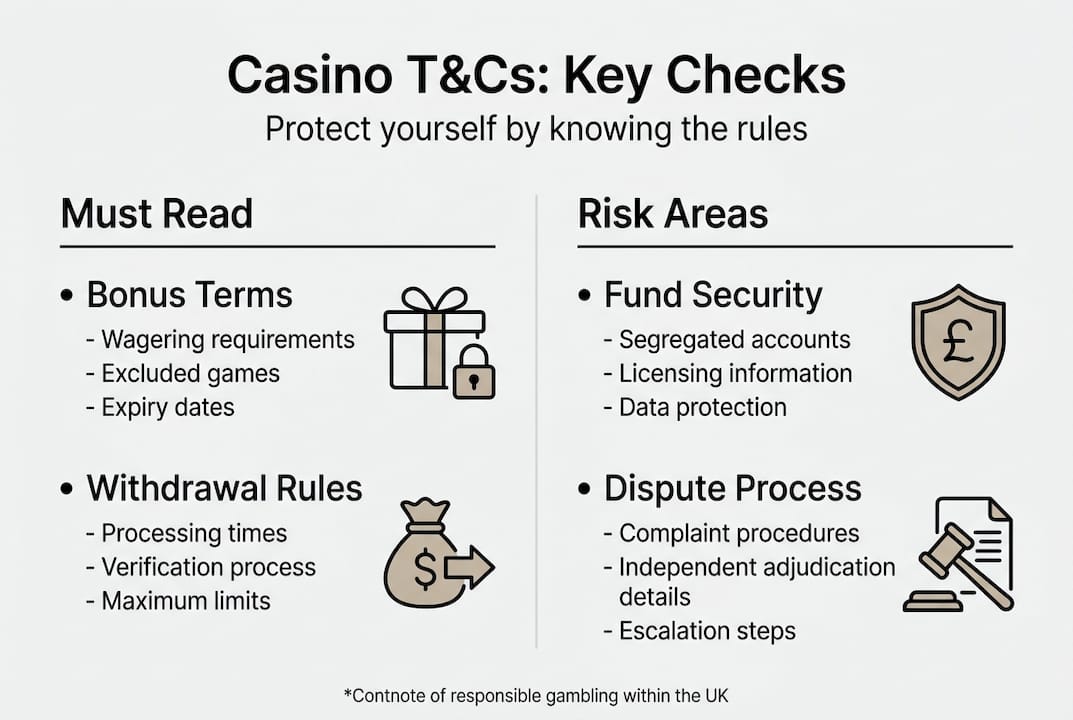
Every bonus is governed by strict rules. Missing even one condition, such as playing a restricted game or letting the bonus expire, can void your winnings entirely. Understanding bonus terms UK casinos attach to their offers is therefore not optional; it’s essential.
Here’s a comparison of what separates a fair bonus from a stingy one:
| Term | Lenient | Standard | Stingy |
|---|---|---|---|
| Wagering requirement | 20x or less | 30x to 35x | 50x or more |
| Expiry period | 30 days | 14 to 21 days | 7 days or less |
| Game restrictions | Slots and table games | Slots only | Specific slots only |
| Max withdrawal cap | Unlimited | 3x to 5x bonus | £50 or fixed cap |
| Minimum deposit | £10 | £20 | £30 or more |
To read bonus clauses properly, follow these steps:
- Find the wagering requirement and multiply it by the bonus amount to calculate the total you must bet before withdrawing.
- Check which games contribute towards clearing the wagering requirement, as table games often contribute 10% or less.
- Note the expiry date and honestly assess whether you can meet the wagering requirement in that window.
- Look for a withdrawal cap on bonus-derived winnings, since some casinos limit payouts to £100 or £200 regardless of what you win.
- Confirm the minimum deposit required to trigger the bonus, as depositing less can disqualify you entirely.
For a deeper look at how bonus wagering explained works in practice, the maths can be surprisingly revealing. A 50x wagering requirement on a £50 bonus means £2,500 in bets before you see a penny. And for a practical walkthrough of claiming offers safely, the bonus redemption steps guide is worth bookmarking.
Pro Tip: If you why check bonus terms isn’t already part of your routine, start now. The difference between a 20x and a 50x wagering requirement on the same bonus is the difference between a realistic reward and a near-impossible one.
How fund protection and security disclosures affect you
Beyond bonuses, T&Cs contain security disclosures that directly affect how safe your money and personal data are. This section is often the most overlooked, yet it carries some of the highest stakes.

UK casinos must clearly disclose fund protection levels and explain how player money is held in the event of insolvency. There are three recognised levels:
| Protection level | What it means | Your risk if casino fails |
|---|---|---|
| Basic | No segregation required | High. Funds mixed with operator money |
| Medium | Some segregation measures | Moderate. Partial recovery possible |
| High | Fully segregated client accounts | Low. Funds protected from creditors |
The difference is significant. At basic protection level, your deposited balance sits alongside the casino’s own operational funds. If the operator becomes insolvent, you join a queue of creditors. At high protection level, your funds are ring-fenced and cannot be touched.
Before registering at any casino, use this checklist:
- Does the T&Cs section name the fund protection level explicitly?
- Are player funds held in a separate bank account from operating funds?
- What encryption standard protects your personal and financial data?
- Is there a named data protection officer or privacy policy reference?
- Which regulatory body oversees the casino’s data handling?
For a full casino security checklist, the questions above form a solid foundation. You should also review safe deposit methods to understand how different payment options add layers of protection. And if you want to understand exactly how operators handle your personal information, protecting your data covers the key requirements UK casinos must meet under GDPR and UKGC rules.
Security disclosures aren’t just legal filler. They’re the clearest signal a casino can send about how seriously it takes your safety.
The hidden costs of skipping casino terms: Our perspective
Here’s what we’ve noticed after reviewing dozens of UK casino disputes: the vast majority don’t happen because a casino acted in bad faith. They happen because a player didn’t read the rules. That’s an uncomfortable truth, but it’s an empowering one.
When you skip the T&Cs, you’re not saving time. You’re borrowing it from a future argument with a support team over a withdrawal you didn’t realise was capped, or a bonus that expired while you were playing the wrong games. The cost of that argument, in stress and lost money, is always higher than the ten minutes of reading you skipped.
The mindset shift we’d encourage is this: treat T&Cs as a filter, not a formality. If a casino’s terms are deliberately opaque, riddled with contradictions, or bury critical information in footnotes, that tells you something important about how they’ll treat you as a customer. Transparent terms are a sign of a trustworthy operator.
Once you make reviewing T&Cs a habit, it becomes quick. You’ll know exactly what to look for, and you’ll spot a problematic clause in seconds. Our deep-dive on casino T&Cs can help you build that habit faster.
Find trusted bonuses and safe casinos with Geeky Gambler
If this article has made you want to approach your next casino sign-up more carefully, you’re already ahead of most players.

At Geeky Gambler, we only feature latest UK casino bonuses from licensed, terms-transparent operators. Every review we publish checks the fund protection level, bonus conditions, and security disclosures so you don’t have to start from scratch. We also cover trusted game providers so you can see exactly whose software is powering the games you play. Whether you’re comparing welcome offers or checking a casino’s withdrawal policy, our guides give you the clarity to play smarter and safer in 2026.
Frequently asked questions
Do I have to read the full terms and conditions at an online casino?
You don’t need to read every word, but you should review the sections covering bonuses, withdrawals, and fund security, as key disclosures including fund protection must be acknowledged before depositing.
What happens if I break a casino’s terms and conditions?
Breaking the terms can result in forfeited winnings, a closed account, or withheld withdrawals, even if the breach was unintentional rather than deliberate.
Are UK casinos legally required to explain fund protection in their terms?
Yes. UK regulations demand full disclosure of customer fund protection levels and require your explicit acknowledgment before any money is deposited.
Which bonus terms are most important to read?
Focus on wagering requirements, expiry dates, game restrictions, and maximum withdrawal limits, as these four clauses have the greatest impact on whether you can actually keep your winnings.


