
Step-by-step responsible gambling: Your guide to safer UK play
TL;DR:
- Verify UKGC license and set personal limits before gambling starts.
- Use responsible tools like reality checks and session time-outs consistently.
- Self-exclusion is a key option when limits and tools no longer ensure safe play.
Online gambling is genuinely enjoyable when approached with a clear head and firm boundaries, yet the ease of access makes it all too simple to lose track of time, money, and intention. Gambling participation sits at 46% of UK adults in the past four weeks (2024, Wave 4), a figure that underlines just how mainstream it has become. That popularity is not a problem in itself. The problem arrives when players jump in without preparation. This guide walks you through every practical step, from checking a site’s licence to activating self-exclusion, so your gambling stays an entertainment choice rather than a financial burden.
Table of Contents
- Before you start: What you need for safe gambling
- Set up your limits: The foundation of responsible play
- Make the most of built-in responsible gambling tools
- Taking action: When and how to self-exclude
- Common pitfalls and troubleshooting tips
- Our perspective: Why responsible gambling requires more than tools
- Looking for safe and innovative gaming?
- Frequently asked questions
Key Takeaways
| Point | Details |
|---|---|
| Stick to strict limits | Set hard boundaries on deposits, losses, and time to maintain control. |
| Use built-in safety tools | Leverage all operator tools like time-outs, reality checks, and activity logs for safer play. |
| Self-exclusion is effective | When in doubt, use self-exclusion schemes and extra support to reinforce quitting or pausing. |
| Stay vigilant for pitfalls | Avoid chasing losses and be alert to signs of risky behaviour or loss of control. |
Before you start: What you need for safe gambling
With the stakes clarified, it is crucial to know what to get in place before your first (or next) bet. Safe gambling does not begin the moment you click “deposit.” It begins well before that, in the choices you make about where you play and how you prepare.
Verify the licence first. Every reputable UK site should display a Gambling Commission badge in its footer. UKGC-licensed sites are legally required to offer mandatory player protection tools, strict age verification, and a clear dispute resolution process. Playing on an unlicensed site removes all of those safeguards instantly. Understanding UK gambling laws gives you a clearer picture of what protections you are legally entitled to as a player.
Separate your gambling funds. Many experienced players use a dedicated e-wallet or a prepaid card loaded with only their gambling budget. Once that balance is gone, the session ends. There is no dipping into rent money, no “I’ll pay it back next week” reasoning. This single habit prevents the vast majority of financial harms associated with recreational gambling.
Check your mindset honestly. Are you gambling to have fun, or are you gambling to recover a previous loss? That distinction matters enormously. Gambling should be treated as paid entertainment, similar to buying a cinema ticket. You go in expecting to spend a fixed amount in exchange for an experience, not a guaranteed return.
Here is a quick pre-session checklist to run through every time:
- Confirm the site’s UKGC licence is active via the public register
- Set a hard deposit limit before you top up your account
- Allocate a specific time window and stick to it
- Log your starting balance so you can track actual spend
- Confirm you are playing for enjoyment, not to solve a money problem
| Preparation step | Why it matters | Time required |
|---|---|---|
| Verify UKGC licence | Ensures legal protections apply | 2 minutes |
| Set deposit limit | Caps total spend automatically | 1 minute |
| Separate gambling funds | Prevents overspend into essential money | 5 minutes |
| Check your mindset | Reduces emotional gambling risk | Ongoing |
| Log starting balance | Creates a clear spending record | 30 seconds |
Pro Tip: Set your deposit limit before you fund your account. Most platforms apply new limits after a 24-hour cooling-off period, so configuring them early removes the temptation to override them mid-session.
Set up your limits: The foundation of responsible play
Once you have checked your preparations, the next step is to personalise your play with firm boundaries. Limits are not restrictions on your enjoyment; they are the architecture that makes enjoyment sustainable over weeks, months, and years.

The 1% rule is your starting point. The principle behind responsible limits suggests you should deposit no more than 1% of your monthly take-home pay in any single gambling period. So if you earn £2,500 per month after tax, your gambling budget is £25. It sounds modest, but it reflects the reality that gambling is a form of entertainment spending, not investment. Stretch it to 5% and you are already risking money that should cover essentials.
Layer your limits for maximum protection. A deposit limit alone is useful, but it works best when combined with a loss limit and a session time limit. Consider this approach:
- Log in to your account settings and locate the “Responsible Gambling” or “Player Protection” section
- Set a daily, weekly, or monthly deposit limit that reflects your 1% budget
- Enable a loss limit at or below your deposit limit (many players set it at 75% of their deposit)
- Activate a session time limit of no more than 60 minutes per sitting
- Turn on a reality check notification every 20 or 30 minutes as an additional reminder
- Review all settings monthly and adjust only downward, never upward in the heat of the moment
The data backs this approach. Loss limits reduce session losses by 35% according to Gambling Commission research, a meaningful reduction that demonstrates these tools genuinely work when used consistently. During Safer Gambling Week 2023, 54% of first-time limit users chose deposit limits as their first protective step, showing that awareness campaigns do shift behaviour in a positive direction.
Statistic callout: Players who set limits before their first session are significantly more likely to maintain those limits long-term than those who attempt to set them mid-play. Preparation, not willpower, is the reliable strategy.
Exploring enabling safer play tools in more detail will show you exactly how to navigate these settings on the most popular UK platforms. If you want to understand the broader framework behind wagering responsibly, our responsible wagering guide covers the principles in practical depth.
Pro Tip: Never increase a limit during an active session. Most UKGC platforms enforce a 24-hour delay on limit increases precisely because impulsive decisions in the moment tend to override good intentions made in a calmer state.
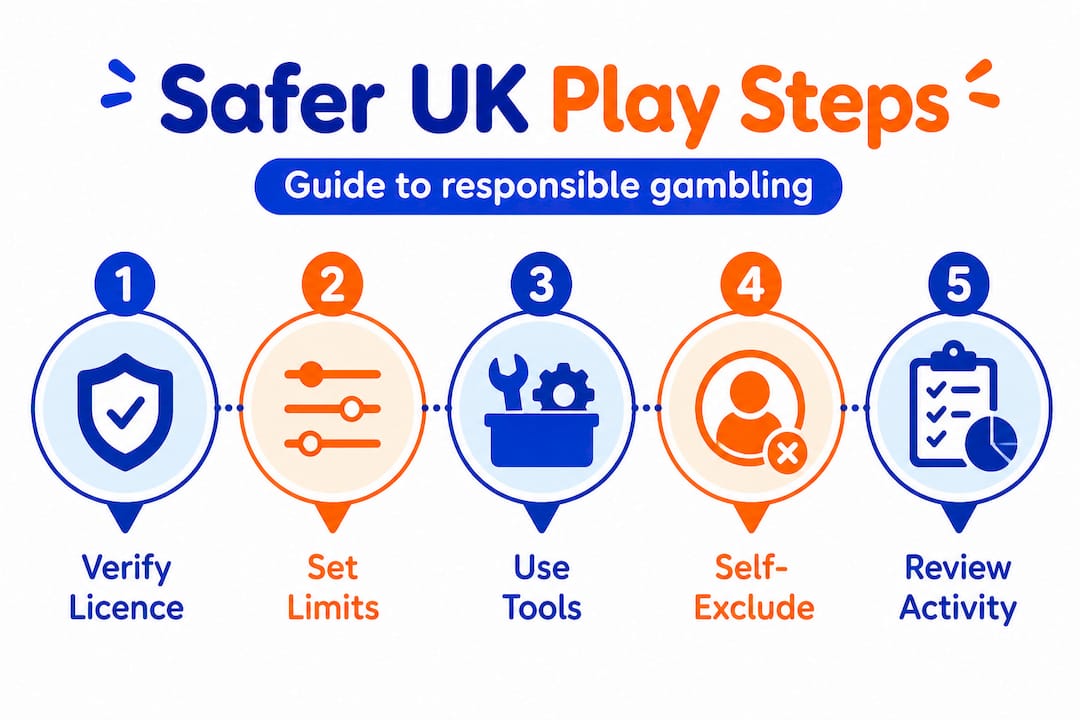
Make the most of built-in responsible gambling tools
With personal limits in place, get the most out of the technical defences UKGC-licensed operators provide. These tools exist because operators are legally obligated to support your ability to play responsibly, and the best platforms make them genuinely easy to find and activate.
Reality checks are pop-up notifications that appear at intervals you choose, typically every 15, 30, or 60 minutes. They display how long you have been playing and how much you have spent or won in that session. They are deliberately simple, designed to interrupt the flow state that makes it easy to lose track of time. Cooling-off periods range from 24 hours to 6 weeks and can be activated instantly, giving you a pause without the permanence of full self-exclusion.
Activity statements are often overlooked but deeply useful. These are downloadable logs of your gambling history, showing deposits, withdrawals, wins, and losses over a chosen period. Reviewing yours monthly is one of the most honest ways to assess whether your gambling behaviour is trending in a healthy direction.
| Tool | Best used when | How to activate |
|---|---|---|
| Reality check | Playing for more than 30 minutes | Account settings, “responsible gambling” tab |
| Session time-out | You need a firm stop time | Set before each session begins |
| Activity statement | Monthly review of spending | Download from account history |
| Cooling-off period | Feeling urge to chase losses | Instant activation, cannot be reversed early |
| Deposit limit | Every time you fund an account | Mandatory to set on first deposit at many sites |
Be aware of specific game mechanics that make these tools even more important. Near-misses in slots create false excitement, triggering a sense of “almost winning” that encourages continued play beyond what is rational. This is a deliberate feature of many slot designs, not an accident. Pre-set limits and reality checks act as a circuit breaker against this psychological pull. Sessions lasting over one hour significantly increase the risk of time distortion, where players genuinely lose track of how long they have been playing.
- Enable reality checks at the start of every session, not after you feel you need one
- Review your activity statement at the end of each month as a non-negotiable habit
- Use cooling-off periods proactively, not just reactively, to build in planned breaks
- Check UK player safety tools for a breakdown of which platforms offer the strongest built-in protections
“The most effective responsible gambling tools are not the ones that stop you in a crisis. They are the ones you set up before you ever feel like you need them.” This principle is central to how the Responsible tools guide frames safer play for UK players.
Taking action: When and how to self-exclude
Sometimes, the best safeguard is to step away, temporarily or for good. Here is what to know about self-exclusion.
Self-exclusion is not a sign of failure. It is a sign of self-awareness, and it is one of the most powerful tools available to any UK gambler who recognises that limits and time-outs are no longer sufficient. Knowing when to use it is just as important as knowing how.
Signs you may need to self-exclude:
- You have exceeded your deposit limit more than once in a month
- You are gambling to recover previous losses rather than for enjoyment
- Gambling is affecting your sleep, relationships, or work performance
- You feel anxious or irritable when you are not gambling
- You have been lying to people close to you about how much you are spending
How to use GAMSTOP step by step:
- Visit the GAMSTOP website and create a free account with your name, date of birth, and email
- Select your exclusion period: six months, one year, or five years
- Confirm your registration and receive a confirmation email within 24 hours
- GAMSTOP applies across all UKGC-licensed sites automatically, without you needing to contact each operator individually
- For land-based venues, contact each venue’s self-exclusion scheme directly or use multi-operator schemes coordinated by your local authority
| Self-exclusion type | Duration options | Coverage |
|---|---|---|
| GAMSTOP (online) | 6 months, 1 year, 5 years | All UKGC-licensed online sites |
| Land-based multi-operator | Variable by scheme | Betting shops, casinos, arcades in a region |
| Individual operator | Varies | Single operator only |
| Bank blocks | Ongoing until removed | Gambling merchant category codes |
Self-exclusion works best as part of a wider support plan. Think of it as a speed bump rather than a permanent solution; it buys you time and removes immediate access, but it works most effectively when combined with cognitive behavioural therapy, blocking software like Gamban, and bank-level gambling blocks offered by most major UK banks.
Pro Tip: Activate your bank’s gambling block the same day you register with GAMSTOP. These blocks apply at the payment level, meaning even unlicensed sites become much harder to fund, adding a second layer of protection that does not rely on site-level controls.
Explore UK self-exclusion options for a full breakdown of how each scheme works and how to stack them effectively.
Common pitfalls and troubleshooting tips
Even with all the right steps in place, mistakes can creep in. Spot and fix these hiccups early to stay on course.
The most common responsible gambling failure is not ignorance. It is complacency. Players who set limits, use tools, and feel confident often let those habits slip gradually. One “exception” becomes a pattern before they realise it.
The chasing losses trap is the biggest single risk. After a losing session, the emotional impulse to “win it back” is powerful and almost always leads to worse outcomes. This is because gambling outcomes are independent of each other. Your next spin, hand, or bet has no memory of the previous one. Chasing is a logical error dressed up as a strategy.
Game type matters more than most players realise. Problem gambling can develop in months, not years, particularly with fast-paced games like slots and live casino options. These formats offer rapid repetition, near-miss effects, and high sensory stimulation, all of which compress the timeline from casual play to problematic behaviour.
“If you would not spend £100 on a theatre ticket and call it a loss to be recovered, you should not approach gambling losses any differently. The money spent bought the experience.” This reframe helps many players disengage from chasing behaviour more effectively than any technical limit alone.
Here is a troubleshooting checklist for getting back on track:
- Review your activity statement to see actual figures, not memory-based estimates
- Lower your deposit limit immediately if you have exceeded it recently
- Take a minimum 48-hour break before your next session
- Talk to someone you trust about your gambling habits
- Consult the UK safe casino steps resource for a structured reset process
Pro Tip: Set a personal rule that you will never gamble within two hours of receiving a bad financial or emotional shock. Emotional states directly influence risk tolerance, and gambling under stress consistently produces worse decisions and larger losses.
Our perspective: Why responsible gambling requires more than tools
Here at Geeky Gambler, we have reviewed dozens of platforms and spoken to thousands of UK players, and we have noticed something that rarely gets said plainly: responsible gambling is treated almost entirely as an individual responsibility when it is actually a shared one.
The tools described in this guide are genuinely valuable. But they only function within a wider system. Operators bear significant legal duties around customer interaction, risk assessments, and proactive identification of at-risk players. Those duties are not always met with the same enthusiasm as marketing campaigns are run.
What we believe is that individual limits and self-exclusion work best when the culture around gambling also normalises talking openly about risk. When friends, families, and communities treat problem gambling as something shameful rather than something treatable, people delay seeking help. That delay costs them financially and personally.
The conversation is changing, slowly. Understanding what responsible gambling truly means in practice, rather than as a compliance checkbox, is where the real shift happens. We think operators who treat player protection as a genuine priority, not a regulatory burden, produce better long-term outcomes for everyone. They retain loyal, happy players who trust them. Players who feel protected are players who play sustainably.
The uncomfortable truth is that no tool replaces genuine care from operators and genuine awareness from players working together. Both sides have a role to play.
Looking for safe and innovative gaming?
If you have followed the steps in this guide, you are already ahead of most players in terms of preparation and self-awareness. The next step is choosing platforms and game providers who match your commitment to a safe, enjoyable experience.
At Geeky Gambler, we focus on operators and developers who take player safety as seriously as game quality. If you are keen to explore titles from studios with strong responsible gaming track records, our reviews of BGaming safe options and Endorphina casino games highlight providers known for fair mechanics, clear RTP disclosures, and honest game design. These are studios worth knowing about when you want the fun without the hidden risks.
Frequently asked questions
What is the ‘1% rule’ in responsible gambling?
The ‘1% rule’ means you should never deposit more than 1% of your monthly take-home pay for gambling, keeping it firmly in the realm of affordable entertainment.
How do I verify that an online gambling site is UKGC-licensed?
Look for the Gambling Commission badge in the site’s footer and confirm the licence via the UKGC’s publicly searchable online register.
What tools can help me control my gambling sessions?
Session time-outs, deposit limits, loss limits, reality checks, and cooling-off periods are all available on UKGC-licensed platforms and can be configured in your account settings.
How quickly can problem gambling develop?
Problem gambling can develop within months rather than years, particularly among players who favour fast-paced formats like slots and live casino games.
What extra support is available if I need a break from gambling?
GAMSTOP covers all UKGC-licensed online sites for periods between six months and five years, and you can strengthen this with bank gambling blocks and dedicated blocking software such as Gamban.

