

Defining Fair Play in Casinos – Why It Matters for UK Players
Frustration often sets in when UK casino players are unsure whether game outcomes are truly unbiased. The appeal of online gambling lies in excitement and potential rewards, but concerns about fairness can cloud the experience. Thanks to rigorous oversight from the UK Gambling Commission, licensed casinos are subject to comprehensive audits and independent testing, making manipulation virtually impossible. This article breaks down the core definition of fair play, clarifies widespread misconceptions, and highlights the safeguards protecting your gaming journey.
Table of Contents
- Fair Play In Casinos: Core Definition And Misconceptions
- Key Fairness Standards For UK Casinos In 2025
- Types Of Fair Play Processes And Verification
- Legal Obligations And Player Rights Under UK Law
- Risks, Common Pitfalls, And How To Avoid Unfair Play
Key Takeaways
| Point | Details |
|---|---|
| Fair Play Assurance | Fair play in online casinos guarantees transparency, integrity, and player protection through regulated RNG outcomes. |
| Regulatory Oversight | The UK Gambling Commission ensures strict adherence to standards through rigorous testing and ongoing audits. |
| Player Rights | Players are protected by robust legal frameworks, ensuring rights related to financial security and responsible gambling. |
| Risk Awareness | Understand potential pitfalls in online gambling and always verify a casino’s licensing to safeguard your experience. |
Fair play in casinos: Core definition and misconceptions
Fair play in online casinos represents a fundamental guarantee of transparency, integrity, and player protection within the gambling ecosystem. At its core, fair play means that every game offers equal and unbiased chances of winning, with outcomes determined purely by random number generators (RNGs) and not manipulated by the casino operator.
The UK Gambling Commission plays a pivotal role in maintaining these standards through rigorous oversight. Strict regulatory checks ensure that online gambling platforms operate with complete transparency and mathematical integrity. These checks involve comprehensive testing of game software before release and ongoing audits to verify:
- Random number generator accuracy
- Consistent return-to-player (RTP) percentages
- Absence of algorithmic manipulation
- Transparent game mechanics
Despite these robust protections, several persistent misconceptions about casino fairness continue to circulate among players. Many believe that casinos can directly influence game outcomes or artificially reduce winning probabilities. However, independent third-party audits make such manipulation virtually impossible for licensed operators.
Licensed casinos must adhere to strict regulatory frameworks that mandate complete game fairness. This means every spin, card draw, or dice roll is genuinely random and cannot be predicted or manipulated by the casino. The mathematical principles underlying casino games are designed to provide a long-term statistical advantage to the house, but this doesn’t mean individual game outcomes are predetermined.
Here’s a comparison of common misconceptions versus actual fair play practices in UK online casinos:
| Misconception | Reality According to UK Regulation |
|---|---|
| Casinos can influence game outcomes | Independently tested RNGs determine all outcomes |
| High wins trigger lower future odds | Each bet is statistically independent |
| Operators adjust games after losses | Ongoing audits prevent algorithmic manipulation |
| Licensed sites may hide payout data | RTP rates and audits are regularly published |
Pro tip: Always verify a casino’s licensing status with the UK Gambling Commission before playing to ensure you’re accessing a platform committed to fair play standards.
Key fairness standards for UK casinos in 2025
In 2025, the United Kingdom continues to lead global standards for online gambling fairness through comprehensive regulatory frameworks designed to protect players and ensure transparent gaming environments. The UK Gambling Commission has implemented increasingly sophisticated mechanisms to maintain the highest levels of player protection and game integrity.
Mandatory consumer protection regulations now require online casinos to integrate several critical safeguards:
- Mandatory deposit limits before initial account funding
- Regular prompts for players to review account spending limits
- Enhanced transparency regarding player fund protection
- Clear communication of potential gambling risks
- Mandatory cooling-off periods for high-risk gambling behaviour
These regulatory standards represent a significant evolution in gambling oversight. Modernised casino regulations now cover both digital and physical gambling platforms, ensuring consistent protection across all gambling environments. The updated frameworks demonstrate a proactive approach to addressing potential gambling-related harms while maintaining player autonomy.
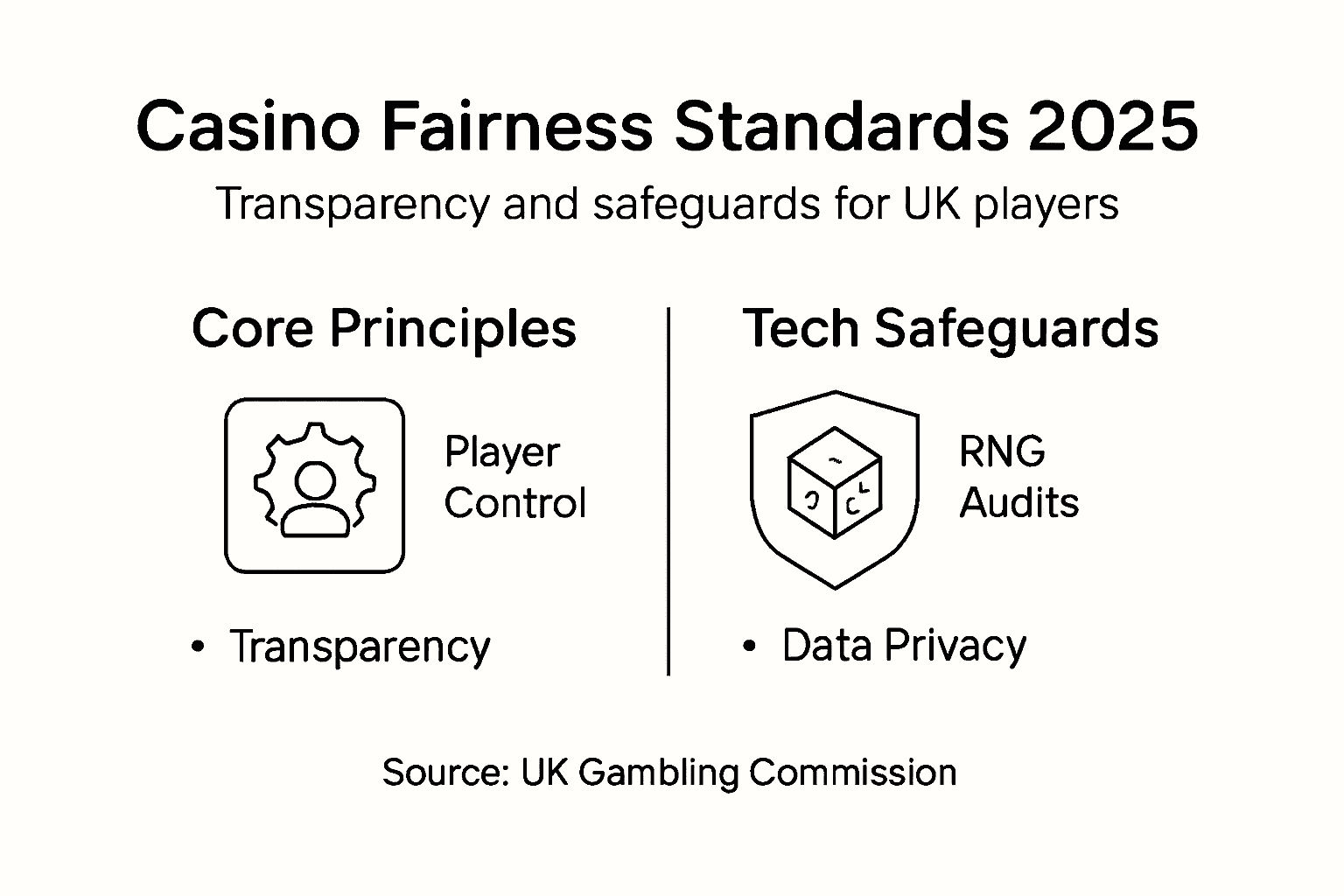
Key fairness standards in 2025 fundamentally revolve around transparency, player control, and robust technical safeguards. Casinos must now provide comprehensive information about game mechanics, implement sophisticated random number generation technologies, and offer clear pathways for players to manage their gambling activities responsibly.
Pro tip: Always check a casino’s current licensing status and verify their compliance with the latest UK Gambling Commission regulations before creating an account.
Types of fair play processes and verification
Ensuring fair play in online casinos involves a complex system of verification processes designed to protect players and maintain the integrity of digital gambling platforms. Rigorous testing protocols form the foundation of these comprehensive fairness assessments, implemented through multiple interconnected verification mechanisms.
The primary fair play verification processes include:
- Random Number Generator (RNG) Testing
- Independent assessment of game randomness
- Verification that game outcomes cannot be predicted
- Ensuring mathematical fairness across all game types
- Return to Player (RTP) Auditing
- Confirming advertised payout percentages are accurate
- Verifying long-term statistical fairness
- Monitoring consistent game performance
- Operational Compliance Checks
- Reviewing casino software for potential manipulation
- Assessing player protection mechanisms
- Validating transparent gaming practices
Independent certification services play a critical role in maintaining these verification standards. Organisations like eCOGRA conduct comprehensive audits that go beyond basic regulatory requirements, providing an additional layer of player protection and ensuring that online casinos maintain the highest levels of operational integrity.

Technical verification processes are complemented by ongoing regulatory oversight, which includes periodic inspections, mandatory reporting, and the potential for immediate licence suspension if fairness standards are compromised. This multi-layered approach ensures that UK players can engage with online gambling platforms with confidence in their fundamental fairness and transparency.
Pro tip: Always check for independent certification logos from recognised testing agencies like eCOGRA when selecting an online casino.
Legal obligations and player rights under UK law
The United Kingdom has developed a comprehensive legal framework that meticulously defines player rights and operator obligations in online gambling. UK gambling law reforms in 2025 have significantly enhanced protections for players, introducing robust mechanisms to ensure fair and responsible gambling practices.
Key player rights under current UK legislation include:
- Financial Protection Rights
- Protection against unfair financial losses
- Mandatory affordability assessments
- Transparent fee and bonus structures
- Data and Privacy Rights
- Personal information protection under UK GDPR
- Secure identity verification processes
- Controlled data sharing practices
- Responsible Gambling Protections
- Access to self-exclusion mechanisms
- Mandatory deposit and spending limits
- Proactive harm prevention tools
Regulatory requirements for gambling operators now mandate comprehensive player safeguards. These include strict identity checks, financial vulnerability assessments, and explicit restrictions on potentially harmful gambling features like autoplay on slot machines.
The legal landscape ensures that players have clear recourse through official channels like the UK Gambling Commission, with operators facing significant penalties for non-compliance. This multi-layered approach balances consumer protection with the fundamental right to engage in responsible gambling activities.
Pro tip: Always review the full terms and conditions, and understand your rights as a player before engaging with any online gambling platform.
Risks, common pitfalls, and how to avoid unfair play
Online gambling presents numerous potential risks that UK players must navigate carefully to ensure a fair and secure gaming experience. Unfair casino practices can significantly impact player outcomes, making it crucial to understand and recognise potential warning signs.
Common risks and pitfalls include:
- Misleading Bonus Conditions
- Extremely high wagering requirements
- Hidden withdrawal restrictions
- Complicated bonus terms
- Payment and Withdrawal Issues
- Delayed or withheld winnings
- Arbitrary account restrictions
- Complicated verification processes
- Game Manipulation Risks
- Potentially rigged game mechanics
- Inconsistent return-to-player percentages
- Lack of transparent game auditing
Unlicensed casino risks represent the most significant threat to players. Operators without proper UK Gambling Commission licensing can expose players to multiple dangerous scenarios, including potential data breaches, unresolved disputes, and completely unregulated gaming environments.
Protecting yourself requires vigilance and proactive research. Always verify a casino’s licensing status, read complete terms and conditions, understand wagering requirements, and maintain records of all transactions. Legitimate, licensed casinos provide multiple player protection mechanisms that safeguard your gaming experience.
The following summary outlines major sources of risk in online gambling and effective player safeguards:
| Risk Source | Common Challenge | Player Safeguard Action |
|---|---|---|
| Misleading bonus conditions | Unclear wagering terms | Always screenshot terms before playing |
| Payment and withdrawal delays | Withheld winnings | Maintain records of all transactions |
| Unlicensed operators | No regulatory support | Only choose UKGC-licensed platforms |
| Ambiguous game fairness claims | Inconsistent standards | Look for independent certification logos |
Pro tip: Always screenshot bonus terms, keep detailed transaction records, and only play on UK Gambling Commission licensed platforms to minimise potential risks.
Experience Truly Fair Play With Trusted UK Online Casinos
The challenge many UK players face today is distinguishing genuinely fair casinos from those with misleading claims. This article sheds light on key issues such as Random Number Generator testing, Return to Player auditing, and the importance of licensed operators committed to transparency and player protection. If you want to avoid risks like unfair bonus terms, withdrawn winnings problems, or unlicensed sites that threaten your data and funds, knowing where to turn is essential.

Discover a trusted resource at Geeky Gambler where every casino review verifies fairness standards, licensing compliance, and reliable player safeguards. Benefit from expert insights on casino bonuses, secure payment options, and ongoing industry updates that empower you to make informed decisions. Start exploring our detailed guides and carefully curated casino listings now to play with confidence and prioritise your safety in 2025 and beyond.
Frequently Asked Questions
What does fair play mean in casinos?
Fair play in casinos refers to the principle that every game offers unbiased chances of winning, where outcomes are determined by random number generators (RNGs) and not manipulated by the casino.
How does the UK Gambling Commission ensure fairness in online casinos?
The UK Gambling Commission ensures fairness through rigorous regulatory checks, including comprehensive testing of game software and ongoing audits to verify random number generator accuracy and return-to-player (RTP) percentages.
What are the common misconceptions about fairness in online casinos?
Common misconceptions include the belief that casinos can influence game outcomes or adjust games after players lose. In reality, licensed operators use independently tested RNGs to guarantee fair play.
What rights do players have under UK gambling law?
Players have rights that include financial protection against unfair losses, data privacy under UK GDPR, access to self-exclusion mechanisms, and must be adequately informed about the risks associated with gambling.


