

What Is Casino Encryption? 256-Bit AES Protects UK Players
Many UK players believe encryption guarantees fair gameplay, but that’s a common misconception. Encryption actually protects your personal and financial data from hackers and fraudsters while you play online. This guide clarifies what casino encryption really is, how it works in practice, and how you can verify casino security before placing your first bet in 2026.
Table of Contents
- Introduction To Casino Encryption
- How Encryption Works In Online Casinos
- Regulatory Requirements For Encryption In UK Casinos
- Common Misconceptions About Casino Encryption
- How To Verify Encryption On Online Casino Websites
- Choosing Casinos With Strong Encryption: Tips For UK Players
- Discover Secure UK Casinos With Strong Encryption
Key Takeaways
| Point | Details |
|---|---|
| Encryption protects data, not fairness | Casino encryption secures your personal and financial information but does not ensure game outcomes are fair. |
| UK casinos use military-grade standards | AES-256 encryption and TLS protocols protect player data during transactions and storage. |
| UKGC enforces strict requirements | The UK Gambling Commission mandates TLS 1.2 or higher and AES-256 for all licensed casinos. |
| Verification is straightforward | Check for HTTPS, valid SSL/TLS certificates, UKGC licence, and independent audit seals. |
| Layered security matters most | Strong encryption is one component of comprehensive casino security alongside licensing and audits. |
Introduction to Casino Encryption
Casino encryption is the technology that protects your confidential information using cryptography to scramble data so only authorized parties can read it. When you register at an online casino, deposit funds, or withdraw winnings, encryption guards your personal details and financial data from hackers and fraudsters attempting to intercept that information.
This protection is especially important in the UK where gambling is heavily regulated and player data protection is a legal priority. The UK Gambling Commission requires all licensed operators to implement robust encryption standards to maintain their operating permissions.
Casino security involves layered defenses. Encryption works during transactions when data travels between your device and casino servers, and also protects stored information in casino databases. You’ll see encryption indicators like HTTPS in the website address bar and a padlock icon next to the URL, both confirming the site uses secure protocols.
Pro Tip: Always check the address bar before logging in. If you see “http://” without the “s” or no padlock icon, leave immediately as the site lacks basic encryption.
Understanding how casinos protect data helps you make informed choices about where to play. Encryption alone doesn’t guarantee a casino is trustworthy, but its absence is an instant red flag.
How Encryption Works in Online Casinos
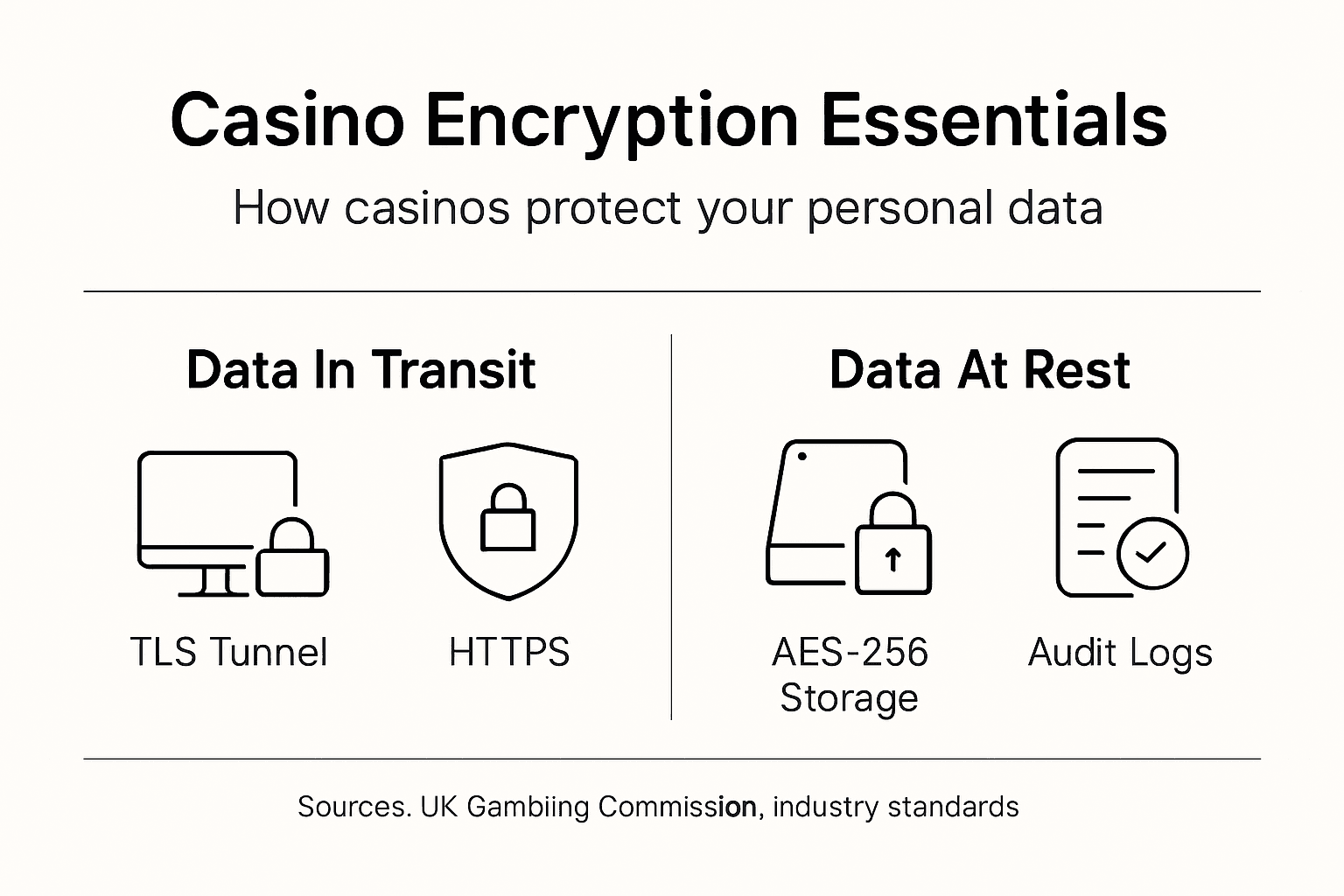
SSL/TLS protocols secure data in transit, creating an encrypted tunnel between your browser and the casino’s servers. When you enter your password or card details, TLS scrambles that information into unreadable code before transmission. Even if intercepted, hackers see only gibberish.
For data at rest, AES-256 encryption protects stored player and financial information in casino databases. This military-grade standard uses 256-bit keys, making brute-force attacks virtually impossible with current technology. UK online casinos commonly deploy this standard to safeguard your details when they’re not actively being transmitted.

The distinction matters because different threats target different stages. Data-in-transit encryption defends against eavesdropping during communication, while data-at-rest encryption protects against database breaches. Reputable casinos implement both layers.
| TLS Version | Security Level | Performance | UK Casino Standard |
|---|---|---|---|
| TLS 1.2 | Strong | Good | Minimum required |
| TLS 1.3 | Strongest | Excellent | Increasingly common |
TLS 1.3 offers faster connection speeds and removes outdated cipher suites that created vulnerabilities in older versions. Many leading UK casinos now deploy TLS 1.3 for enhanced casino data protection.
Pro Tip: Check which TLS version a casino uses by clicking the padlock icon in your browser’s address bar, then viewing certificate details. Look for “TLS 1.3” or at minimum “TLS 1.2”.
Casinos must regularly update encryption protocols to defend against evolving cyber threats. What seemed secure five years ago may have known vulnerabilities today. Licensed operators invest in staying current with SSL encryption standards.
Regulatory Requirements for Encryption in UK Casinos
The UK Gambling Commission enforces encryption and security standards for all licensed operators. These requirements ensure casinos implement baseline protections for player data and financial transactions.
Mandatory standards include TLS 1.2 or higher for all data transmission and AES-256 for stored player information. Licensees must demonstrate compliance during initial licensing and ongoing audits. Failure to maintain these standards results in fines, licence suspension, or permanent revocation.
The UKGC monitors compliance through regular audits and technical assessments. Operators must document their encryption implementations, update protocols promptly when vulnerabilities emerge, and report any data breaches within strict timeframes. These measures make playing on UK gambling regulations compliant sites significantly safer.
Key encryption requirements for UKGC licensees include:
- Implement TLS 1.2 or newer for all player-facing connections
- Use AES-256 or equivalent for database encryption
- Maintain valid SSL/TLS certificates from recognized authorities
- Conduct annual security audits including encryption verification
- Document and update encryption protocols as standards evolve
- Segregate and encrypt financial transaction data separately
Choosing licensed casinos guarantees these protections are in place and regularly verified. Unlicensed sites face no such requirements and often cut corners on expensive security measures.
You can identify secure casinos by verifying their UKGC licence number and checking it against the official register. This simple step confirms the operator meets mandatory encryption standards.
Common Misconceptions About Casino Encryption
Many players confuse encryption with game fairness, but these are entirely separate systems. Encryption protects your data during transmission and storage, while fairness depends on independently audited random number generators that determine game outcomes.
Misconception 1: Encryption guarantees fair games. Reality is that game fairness comes from RNG certification by testing laboratories like eCOGRA or iTech Labs. Encryption has nothing to do with whether slot spins or card shuffles are random.
Misconception 2: Only large transactions need encryption. Every data exchange between you and the casino requires protection, regardless of amount. Hackers target login credentials and personal details just as eagerly as payment information.
Misconception 3: HTTPS and a padlock icon mean total security. These indicators confirm basic encryption is active, but comprehensive security requires valid licensing, independent audits, and transparent policies beyond just encrypted connections.
“Encryption is essential but represents just one layer of casino security. Players need licensing verification, independent game audits, and transparent responsible gambling policies for complete protection.”
Treat encryption as part of an overall security strategy rather than a standalone feature. A casino with strong encryption but no valid licence poses serious risks. Conversely, a licensed casino will always have proper encryption because regulations mandate it.
The casino security checklist combines multiple verification points including encryption, licensing, audits, and payment security. Relying on any single indicator leaves gaps in your protection.
How to Verify Encryption on Online Casino Websites
Verifying casino encryption takes just minutes and dramatically reduces your risk. Follow these practical steps before registering or depositing at any new site.
Step 1: Check the website address starts with “https://” and displays a padlock icon. Click the padlock to view certificate details and confirm it’s valid and issued by a recognized authority like DigiCert or Sectigo.
Step 2: Review the casino’s security or privacy policy for mentions of AES-256 encryption protecting stored data. Reputable operators clearly state their encryption standards in these documents.
Step 3: Verify the casino holds a valid UK Gambling Commission licence. Check the licence number against the official UKGC register to confirm it’s current and the operator name matches exactly.
Step 4: Look for third-party audit seals from organizations like eCOGRA, iTech Labs, or GLI. These certifications confirm independent verification of encryption implementations and overall security.
Step 5: Use browser developer tools or trusted online resources to check TLS versions and cipher strength. Several free websites analyze SSL/TLS configurations and highlight any weaknesses.
Pro Tip: Browser extensions like “SSL Server Test” provide instant encryption analysis with a single click. Install one to quickly verify security before entering any personal information.
You can identify secure casinos by combining these checks into a routine verification process. Bookmark trusted verification tools and the UKGC licence register for quick access.
Understanding SSL encryption in casinos helps you interpret certificate details and recognize when implementations fall short of current standards.
Choosing Casinos with Strong Encryption: Tips for UK Players
Strong encryption should be non-negotiable when selecting where to play. Visible encryption indicators form the foundation of your safety assessment, but smart players verify claims rather than accepting them at face value.
Start by confirming technical details match what casinos advertise. If a site claims bank-level security, verify they actually use TLS 1.2 or higher and AES-256. Check certificates are current and issued by reputable authorities.
An active UK Gambling Commission licence guarantees enforced security standards including mandatory encryption requirements. Licensed operators face regular audits and severe penalties for non-compliance, creating strong incentives to maintain proper protections.
Independent audit seals from recognized testing laboratories provide additional verification. eCOGRA, iTech Labs, and GLI certifications confirm ongoing security assessments including encryption implementations.
Cross-reference multiple security signals rather than relying on any single indicator:
- Valid HTTPS with current SSL/TLS certificate
- Active UKGC licence verified against official register
- Clear security policy stating AES-256 and TLS standards
- Recognized third-party audit seals prominently displayed
- Transparent data protection and privacy policies
- Secure payment processors with PCI DSS compliance
Warning signs of weak encryption or dubious sites include:
- HTTP instead of HTTPS or missing padlock icon
- Expired or self-signed SSL certificates
- No mention of encryption standards in policies
- Missing or unverifiable gambling licence
- Requests to disable security warnings or browser protections
The casino security checklist provides a comprehensive framework for evaluating all security aspects beyond just encryption. Use it alongside encryption verification for complete protection.
You can identify secure casinos efficiently by developing a systematic verification routine. Taking five minutes upfront prevents potentially serious problems later.
Playing exclusively at licensed casinos eliminates most encryption concerns because licensing bodies enforce minimum standards. Unlicensed sites may claim strong encryption but face no independent verification or consequences for false claims.
Discover Secure UK Casinos with Strong Encryption
Now that you understand casino encryption and how to verify it, put that knowledge to work finding trustworthy sites. Geeky Gambler offers comprehensive guides and detailed checklists helping UK players identify casinos with robust encryption and security.

Our curated lists feature only licensed sites with verified encryption standards protecting your personal and financial data. We analyze security implementations so you don’t have to, highlighting operators that exceed minimum requirements.
Explore expert reviews focusing on security features including encryption protocols, data protection policies, and independent certifications. Our online casino security checklist walks you through complete verification.
Learn to identify secure casinos using professional assessment methods. Start your journey at trusted sites with online casinos with no deposit bonuses to test security and gameplay risk-free.
What Is Casino Encryption? Frequently Asked Questions
What does encryption do for my safety on online casino sites?
Encryption scrambles your personal details, login credentials, and financial information into unreadable code during transmission and storage. This prevents hackers from stealing your data even if they intercept communications or breach casino databases.
How can I tell if an online casino is really using strong encryption?
Check for HTTPS in the address bar with a valid padlock icon, then click it to view certificate details confirming TLS 1.2 or higher. Review the casino’s security policy for mentions of AES-256 encryption and verify their UKGC licence requires these standards.
Is encryption the only thing I should check for casino security?
No, encryption is just one component of comprehensive security. You also need valid licensing, independent game fairness audits, transparent policies, and secure payment processing. The casino data protection FAQ covers additional critical factors.
Can encryption prevent me from losing money unfairly in games?
Encryption protects your data but has nothing to do with game fairness or outcomes. Fair gameplay comes from independently certified random number generators that encryption doesn’t affect. You need both strong encryption and verified RNG certification for complete protection.


