

What is casino RTP and how to use it in 2026
You have probably heard other players mention RTP percentages when discussing online slots or table games, but what does this actually mean for your gameplay? Many UK casino enthusiasts misunderstand return to player figures, treating them as guarantees rather than statistical averages. Understanding RTP properly transforms how you select games, manage your bankroll, and set realistic expectations. This guide breaks down casino RTP in plain terms, explains how it affects your chances, and shows you exactly how to use this knowledge to make smarter betting decisions in 2026.
Table of Contents
- Understanding What Casino RTP Means
- How Casino RTP Affects Your Chances
- Variations And Nuances In RTP Across Game Types
- Using RTP To Make Smarter Bets
- Discover Top Online Casinos With High RTP Games Today
- Frequently Asked Questions
Key takeaways
| Point | Details |
|---|---|
| RTP definition | Return to player represents the percentage of total wagers a game returns to players over millions of spins |
| Long-term metric | RTP predicts outcomes across extended play, not individual sessions or short-term results |
| Typical ranges | Slots typically offer 94-97% RTP, whilst table games like blackjack can exceed 99% with optimal strategy |
| Selection tool | Choosing games with higher RTP improves your expected returns when playing regularly |
| Not a guarantee | RTP reflects averages, so volatility and luck still determine individual session outcomes |
Understanding what casino RTP means
Return to player is a percentage that tells you how much of all money wagered on a game will theoretically be paid back to players over time. If a slot has 96% RTP, it means that for every £100 wagered collectively by all players, the game will return £96 on average. The remaining 4% represents the house edge, which is how casinos maintain profitability.
RTP calculations rely on complex mathematical models tested over millions of spins. Game developers programme each title with specific probabilities for different outcomes, and independent testing laboratories verify these figures before games receive licensing approval. Return to player (RTP) percentages represent the average theoretical return on wagers over time, ensuring players understand what to expect from extended gameplay.
The crucial distinction is that RTP measures long-term statistical probability, not short-term results. You might deposit £50 and win £200 in one session, or lose your entire stake in minutes. Neither outcome contradicts the game’s stated RTP because these percentages only become accurate across enormous sample sizes. Think millions of spins by thousands of players, not your personal 100-spin session on a Friday evening.
Random number generators ensure every spin is independent and unpredictable, which means past results never influence future outcomes. The role of RNG in online casinos UK guarantees fairness by producing genuinely random results that align with the programmed RTP over sufficient trials.
Here are the key components that determine RTP:
- Mathematical probability models built into game software
- Symbol frequencies and payout values on reels
- Bonus feature mechanics and their trigger rates
- Independent laboratory testing and certification
- Regular audits by licensing authorities
Pro Tip: Always check the game information screen or paytable before playing, as most reputable slots display their RTP percentage clearly. If you cannot find this information easily, consider choosing a different game from a more transparent provider.
How casino RTP affects your chances
RTP directly influences your expected value, which is the average amount you can anticipate winning or losing per wager over extended play. A game with 97% RTP gives you better long-term prospects than one offering 94% RTP, even though both will produce winning and losing sessions. The difference compounds significantly when you play regularly, making game selection genuinely important for frequent players.
Consider two slots: Game A has 94% RTP whilst Game B offers 97% RTP. If you wager £1,000 on each over multiple sessions, Game A theoretically returns £940 whilst Game B returns £970. That £30 difference might seem modest, but it represents a 50% improvement in your expected outcome. Over thousands of pounds wagered throughout a year, choosing higher RTP games substantially impacts your overall results.

| Game Type | Typical RTP Range | House Edge | Best For |
|---|---|---|---|
| Online Slots | 94-97% | 3-6% | Entertainment and bonus features |
| European Roulette | 97.3% | 2.7% | Simple gameplay with decent returns |
| Blackjack (optimal strategy) | 99-99.5% | 0.5-1% | Players willing to learn basic strategy |
| Video Poker (optimal play) | 98-99.5% | 0.5-2% | Strategic players seeking skill-based games |
| Baccarat (banker bet) | 98.94% | 1.06% | Low house edge with minimal decisions |
Selecting games with higher RTP percentages improves your expected returns in the long run, particularly when combined with disciplined bankroll management.
Follow these steps to assess and choose games with favourable RTP:
- Check the game information screen or help section for stated RTP before playing
- Compare similar games from different providers to identify the highest RTP options
- Research whether table games require optimal strategy to achieve advertised RTP
- Verify that bonus features do not significantly reduce base game RTP
- Consider volatility alongside RTP, as high variance games produce less predictable results
Volatility describes how a game pays out, which is equally important as RTP. A low volatility slot with 95% RTP might provide frequent small wins, whilst a high volatility game with 97% RTP could deliver rare but substantial payouts. Your bankroll size and playing style should influence which combination suits you best.
Pro Tip: Combine RTP knowledge with session budgets and loss limits. Even games with excellent RTP can produce losing streaks, so never chase losses or exceed predetermined spending limits regardless of theoretical return percentages.
Variations and nuances in RTP across game types
RTP varies dramatically between casino game categories, and understanding these differences helps you select games that match your priorities. Slots typically offer the widest RTP range because thousands of titles exist with different mechanics, features, and target audiences. Budget slots might sit at 94% RTP, mainstream titles cluster around 96%, and premium games can reach 97-98%. Table games generally provide higher RTP, especially when you employ optimal strategy.
Blackjack stands out as offering the best RTP in most casinos, frequently exceeding 99% when you follow basic strategy charts. However, this figure drops significantly if you make poor decisions like hitting on 17 or ignoring dealer upcards. Roulette RTP depends entirely on the variant, with European roulette at 97.3% and American roulette falling to 94.74% due to the additional double zero.
Bonus features and game variants substantially impact RTP within the same title. Some slots offer multiple RTP settings, allowing casinos to choose configurations between 94% and 96% for the identical game. RTP can vary within games due to bonus features, game variants, and casino adjustments, which is why checking specific RTP at your chosen casino matters.
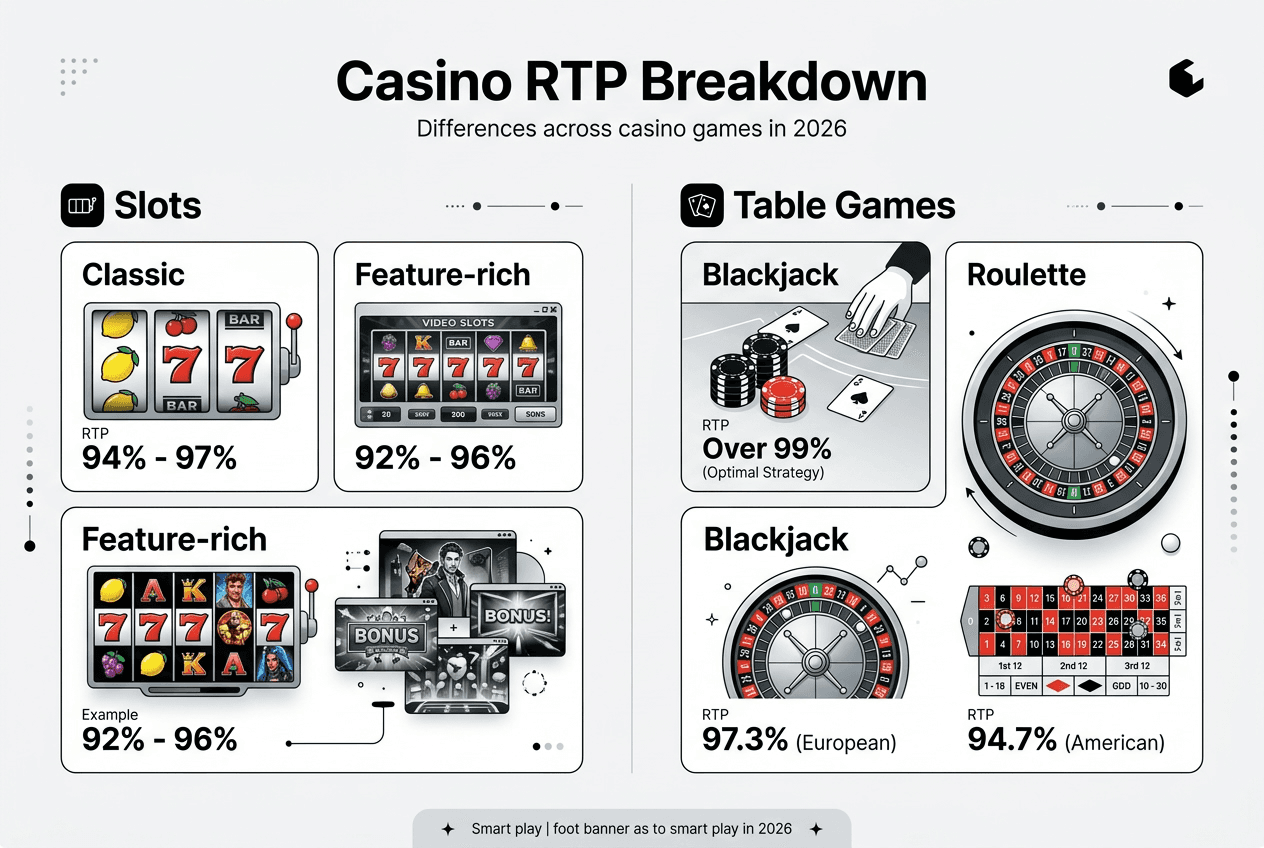
| Game Category | Average RTP | RTP Range | Key Factors |
|---|---|---|---|
| Classic Slots | 95% | 92-97% | Simple mechanics, fewer features |
| Video Slots | 96% | 94-98% | Bonus rounds, free spins, multipliers |
| Progressive Jackpots | 92-95% | 88-96% | Portion of RTP allocated to jackpot pool |
| Live Dealer Games | 97-99% | 95-99.5% | Real-time gameplay with human dealers |
| Scratch Cards | 95% | 90-97% | Instant win mechanics |
Software providers significantly influence RTP standards. NetEnt and Play’n GO typically maintain RTP above 96% across their portfolios, whilst some providers offer configurable RTP that casinos can adjust within regulatory limits. Always verify the specific RTP at your chosen casino rather than assuming it matches figures quoted in reviews.
Factors that alter RTP include:
- Bonus buy features that change base game mathematics
- Progressive jackpot contributions that reduce regular payout RTP
- Game rule variations like blackjack payout ratios or roulette wheel configurations
- Casino-selected RTP settings where providers offer multiple options
- Special promotional modes or tournament formats with modified payout structures
When choosing the right online casino, prioritise operators that display RTP clearly and select higher configuration options when available. Transparency around return percentages indicates a casino that values player trust and operates with integrity.
Using RTP to make smarter bets
Incorporating RTP into your gameplay decisions requires a systematic approach that balances theoretical returns with practical considerations like volatility, bonus terms, and personal entertainment preferences. Start by establishing your priorities, whether maximising playing time, chasing big wins, or optimising long-term value. Your goals determine which RTP and volatility combination suits you best.
Follow this step-by-step process to evaluate games effectively:
- Access the game information screen and locate the stated RTP percentage
- Compare this figure against category averages to assess whether it represents good value
- Check volatility ratings to understand payout frequency and size distribution
- Review bonus terms if using promotional funds, as wagering requirements interact with RTP
- Verify the casino holds valid UK Gambling Commission licensing for regulatory protection
- Start with small stakes to experience gameplay before committing larger amounts
Verifying RTP information requires checking multiple sources. Reputable casinos display RTP in game information screens, but you can cross-reference these figures on provider websites or independent testing laboratory reports. eCOGRA, iTech Labs, and Gaming Laboratories International publish audit certificates that confirm stated RTP percentages match actual game performance.
Combining RTP knowledge with strategic play and casino bonus awareness helps maximise your advantage when playing regularly. Understanding how wagering requirements interact with game RTP prevents choosing titles that make bonus clearing unnecessarily difficult.
Bankroll management remains essential regardless of RTP. Allocate specific session budgets, set win and loss limits, and never chase losses even when playing high RTP games. A 98% RTP game still has a house edge, meaning extended play favours the casino mathematically. Treat gambling as entertainment with costs, not an income strategy.
Pro Tip: Track your results across multiple sessions to see how your actual returns compare to theoretical RTP. This practice builds realistic expectations and helps you recognise when variance is producing unusual results. Most players experience returns within 5-10% of stated RTP over hundreds of gaming sessions.
Prioritising games with RTP above 96% provides measurable advantages for regular players. The difference between 94% and 97% RTP might seem small, but it compounds significantly across thousands of spins. If you play slots frequently, this single factor can determine whether you enjoy extended entertainment or deplete your bankroll quickly.
Consider volatility alongside RTP when selecting games. Low volatility titles with 96% RTP often provide better value for recreational players than high volatility games at 97% RTP, because frequent small wins extend playing time and reduce the risk of rapid losses. Match your game selection to your bankroll size and risk tolerance rather than chasing the absolute highest RTP regardless of other factors.
Discover top online casinos with high RTP games today
Now that you understand how RTP works and why it matters, you can apply this knowledge to find the best gaming opportunities available to UK players in 2026. Geeky Gambler provides comprehensive reviews of licensed online casinos, highlighting operators that offer transparent RTP information and excellent game selections from top providers.

Explore our curated best online casino bonuses to find welcome offers, free spins, and cashback deals that complement high RTP gameplay. We verify every promotion for fair terms and genuine value, ensuring you start with advantages that enhance your entertainment budget.
Discover premium game providers known for player-friendly RTP percentages. BGaming casino games consistently deliver engaging titles with competitive return rates, whilst Pragmatic Play casinos and games offer extensive portfolios featuring some of the industry’s most popular high RTP slots. Our detailed provider guides help you identify which studios prioritise player value through transparent mathematics and fair gameplay.
Frequently asked questions
What exactly is casino RTP?
Return to player is a percentage showing how much of all wagered money a casino game pays back to players over millions of spins. A slot with 96% RTP returns £96 for every £100 wagered collectively by all players, with the remaining 4% representing the house edge. This figure represents long-term statistical averages, not guaranteed outcomes for individual sessions.
Can high RTP guarantee I will win?
No, RTP reflects long-term averages across millions of spins, not short-term results for individual players. You might win substantially or lose your entire stake in a single session regardless of RTP. Random number generators ensure every spin is independent, so past results never influence future outcomes. RTP simply indicates better expected value over extended play.
Where can I find RTP information for casino games?
Most reputable online slots display RTP in the game information screen, accessible through a settings or help button. Table games typically show RTP in their rules sections. You can also check game provider websites or independent testing laboratory reports for verified figures. If a casino does not display RTP clearly, consider this a red flag regarding transparency.
What is the difference between RTP and house edge?
RTP and house edge are complementary figures that always total 100%. If a game has 96% RTP, the house edge is 4%. RTP represents the percentage returned to players, whilst house edge shows the casino’s mathematical advantage. Both describe the same relationship from different perspectives, with higher RTP meaning lower house edge.
Does RTP vary between different online casinos?
Yes, some game providers offer configurable RTP settings, allowing casinos to choose between multiple options for the same title. A slot might be available in 94%, 95%, and 96% RTP versions. Always check the specific RTP at your chosen casino rather than assuming it matches figures from reviews. Reputable operators display this information transparently in game screens.
How does RTP affect bonus wagering requirements?
Games with higher RTP generally make bonus wagering more efficient because you retain more of your balance through each betting cycle. However, many casinos exclude high RTP games from bonus play or weight them differently in wagering calculations. Always review bonus terms to understand which games contribute fully and whether restrictions apply to titles exceeding certain RTP thresholds.


