

Role of auditing in casinos: ensuring fairness 2026
Rigorous auditing reduces fraud incidents in online casinos by up to 75% within the first year of implementation, demonstrating its critical importance for UK operators and regulators. Casino auditing systematically verifies game fairness, regulatory compliance, and operational integrity to protect players and maintain market trust. This guide explores how auditing practices ensure fairness, support compliance with UK Gambling Commission standards, and provide actionable frameworks for implementing robust audit processes in 2026.
Table of Contents
- Introduction To Casino Auditing
- How Auditing Ensures Fairness In Online Casinos
- Auditing’s Role In Regulatory Compliance And Player Protection
- Common Misconceptions About Casino Auditing
- Internal Vs External Audits: What Operators And Regulators Should Know
- Technological Advances Enhancing Casino Auditing
- Practical Guide To Implementing Effective Auditing In UK Online Casinos
- Conclusion: Elevating Fairness And Trust Through Auditing
Key takeaways
| Point | Details |
|---|---|
| Auditing ensures fairness and compliance | Systematic verification of game outcomes and regulatory adherence protects players and operators alike. |
| Fraud reduction proven effective | Robust audits report up to 75% fewer fraud-related complaints in year one of implementation. |
| Internal and external audits complement | Operators conduct internal checks whilst independent third parties provide mandated regulatory verification. |
| Technology enhances transparency | Blockchain, automation, and analytics improve audit accuracy, speed, and ongoing compliance monitoring. |
| Implementation requires structured approach | Planning, risk assessment, testing, reporting, and continuous monitoring form the foundation of effective auditing. |
Introduction to casino auditing
Casino auditing represents a systematic examination of fairness, compliance, and operational practices within online gambling platforms. In the UK’s strictly regulated environment, regular independent auditing for licensed online casinos ensures transparency and adherence to statutory requirements. This process verifies that games operate fairly, financial transactions remain secure, and operators meet ethical obligations.
Three key stakeholders benefit from rigorous auditing practices:
- Online casino operators who maintain licensing and build player trust through verified fairness
- UK Gambling Commission regulators who enforce compliance and protect consumers
- Players who deserve assurance that outcomes are random and operations are transparent
Auditing serves as a mandated regulatory tool that transforms abstract compliance requirements into concrete verification. Operators must demonstrate fairness not through claims alone but through documented evidence from independent assessors. This verification process establishes credibility in a market where player confidence directly influences business success.
The UK Gambling Commission positions auditing as non-negotiable for licensed operations. Operators failing to meet audit standards face sanctions ranging from fines to licence suspension. Understanding how to verify casino fairness uk standards requires grasping both technical verification methods and regulatory expectations that shape the industry landscape.
How auditing ensures fairness in online casinos
Fairness verification begins with technical validation of Random Number Generators that determine game outcomes. Independent certification bodies test RNG algorithms against statistical randomness standards, ensuring each spin, card deal, or dice roll remains unpredictable and unbiased. These tests analyse millions of outcomes to detect patterns that would indicate manipulation or technical flaws.
ECOGRA and similar accredited organisations conduct scheduled audits examining:
- RNG software source code and mathematical models for compliance with fairness standards
- Game payout percentages against advertised Return to Player rates across extended play periods
- System integrity checks verifying no unauthorised modifications occurred between audit cycles
- Player account management systems for proper segregation of funds and withdrawal processing
Audit schedules vary based on risk assessment and regulatory requirements. High-risk games or newly launched platforms undergo quarterly reviews whilst established operations face annual comprehensive audits. Annual audits reduce fraud incidents by detecting anomalies in player accounts, transactions, and game outcomes before causing major losses.
Anomaly detection systems flag unusual patterns such as improbable winning streaks, suspicious betting behaviours, or technical glitches affecting outcomes. Auditors investigate these flags to determine whether they represent statistical variance, technical errors, or deliberate manipulation. Early detection prevents minor issues from escalating into major player disputes or regulatory violations.
Pro Tip: Understanding the role of RNG online casinos uk helps operators communicate fairness guarantees effectively to players, building trust through transparency about technical safeguards.
Auditing’s role in regulatory compliance and player protection
The UK Gambling Commission establishes comprehensive audit mandates requiring regular independent verification for all licensed operators. These requirements cover technical systems, financial controls, and responsible gambling measures. Operators must submit audit reports demonstrating compliance across multiple regulatory dimensions.
Fraud prevention represents a primary audit focus, examining:
- Transaction monitoring systems that flag suspicious deposits, withdrawals, or betting patterns
- Anti-money laundering controls verifying customer identification and source of funds
- Account security measures protecting player data and preventing unauthorised access
- Bonus abuse detection identifying coordinated exploitation of promotional offers
Responsible gambling audits assess whether operators implement required player protection tools. Auditors verify deposit limits function correctly, self-exclusion mechanisms operate across all platforms, and marketing materials avoid targeting vulnerable individuals. These checks ensure operators fulfil ethical obligations beyond mere legal compliance.

Regulatory enforcement relies heavily on audit findings. The Commission reviews submitted reports when making licensing decisions, investigating complaints, or conducting targeted compliance assessments. Casinos implementing robust audits report up to a 75% reduction in fraud-related complaints within the first year, demonstrating tangible benefits for diligent operators.
Audit transparency supports player confidence and market integrity. When operators publish certification from recognised auditing bodies, players gain assurance that fairness claims rest on independent verification rather than self-assessment. This transparency distinguishes reputable operators from less scrupulous competitors, creating competitive advantages for those prioritising fair play in casinos uk operations.
Common misconceptions about casino auditing
Many stakeholders harbour misconceptions about audit scope and guarantees that require clarification. Understanding these limitations helps operators set realistic expectations whilst maintaining commitment to rigorous verification processes.
Auditing significantly reduces fraud risk but cannot guarantee absolute prevention. Sophisticated fraudsters continually develop new exploitation methods that may escape detection between audit cycles. Operators must combine regular audits with ongoing monitoring, staff training, and rapid response protocols to maintain robust defences against evolving threats.
Key distinctions between audit types often cause confusion:
- Internal audits conducted by operator staff examine operational controls but lack independence
- External audits performed by accredited third parties provide regulatory-grade verification
- Self-assessments offer operational insights but carry no regulatory weight
- Compliance reviews by the Gambling Commission focus specifically on regulatory adherence
Player trust depends on audit results plus operator transparency and responsive customer service working together to demonstrate genuine commitment to fair treatment.
Some believe certification guarantees perfect fairness indefinitely. In reality, audits provide snapshots of compliance at specific times. Software updates, system changes, or operational modifications between audits may introduce new risks. This reality underscores why regulations mandate audits after significant operational changes, not just on fixed schedules.
Communicating audit limitations openly actually strengthens player trust rather than undermining it. Players appreciate operators who explain both what audits verify and what they cannot guarantee. This honest approach aligns with broader industry emphasis on transparency casinos uk player trust, differentiating ethical operators from those making unrealistic fairness claims.
Internal vs external audits: what operators and regulators should know
Internal audits serve operational purposes, allowing operators to identify control weaknesses and process improvements before external scrutiny. Staff auditors examine daily operations, financial controls, and compliance procedures using checklists aligned with regulatory requirements. These reviews provide continuous improvement feedback but lack the independence regulators demand.
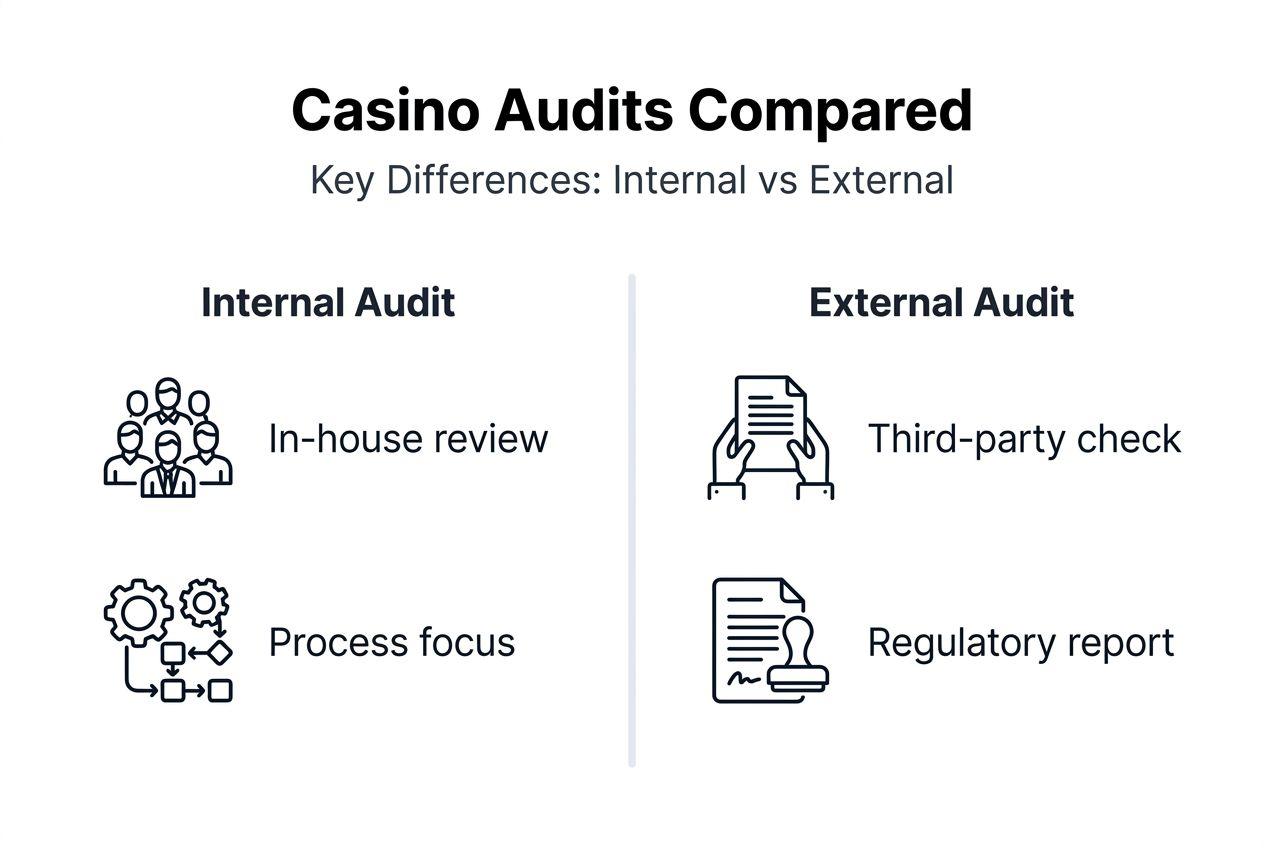
External audits performed by accredited third parties meet regulatory mandates through independent verification. The UKGC requires licensed operators to engage recognised auditing firms with gambling industry expertise. These auditors bring specialised technical knowledge, statistical analysis capabilities, and objectivity that internal teams cannot replicate.
| Audit Type | Independence | Regulatory Value | Primary Focus | Frequency |
|---|---|---|---|---|
| Internal | Low (conducted by operator staff) | Operational insights only | Process improvement and control testing | Continuous or quarterly |
| External | High (independent third parties) | Meets licensing requirements | Compliance verification and fairness testing | Annual minimum plus change-triggered |
| Regulatory | Complete (UKGC direct inspection) | Enforcement basis | Targeted compliance investigation | As needed for complaints or reviews |
Both audit types complement rather than replace each other. Internal audits identify issues early, allowing correction before external reviews. External audits provide independent verification that internal controls function effectively. Operators maximising both approaches demonstrate commitment to comprehensive compliance.
Regulatory consequences for inadequate auditing prove severe. At least 5 major UKGC license reviews or suspensions since 2023 involved insufficient auditing and reporting failures. These cases highlight how audit deficiencies signal broader operational and compliance problems that regulators cannot tolerate.
Pro Tip: Operators should view external audits as opportunities for improvement rather than mere compliance exercises, using findings to strengthen online casino security checklist uk implementations across all operational areas.
Technological advances enhancing casino auditing
Blockchain technology creates immutable audit trails that revolutionise verification processes. Every transaction, game outcome, and system change recorded on blockchain cannot be altered retroactively, providing auditors with tamper-proof evidence. This transparency allows real-time verification rather than periodic snapshots, fundamentally improving audit reliability and reducing disputes.
Automation tools transform audit efficiency:
- Continuous monitoring systems flag anomalies instantly rather than waiting for scheduled reviews
- Automated testing suites run thousands of RNG checks daily, identifying deviations immediately
- Report generation tools compile compliance documentation automatically, reducing manual errors
- Alert systems notify operators and regulators simultaneously when thresholds are breached
Data analytics enhance anomaly detection beyond simple statistical tests. Machine learning algorithms identify subtle patterns indicating potential fraud, technical glitches, or operational irregularities that traditional methods might miss. These systems learn from historical data, improving detection accuracy over time whilst reducing false positives that waste investigative resources.
Shorter audit cycles enabled by technology benefit all stakeholders. Operators receive faster feedback on compliance status, allowing prompt corrections. Regulators access near-real-time compliance data rather than relying on annual reports that may be outdated upon submission. Players benefit from continuously verified fairness rather than periodic certification.
Ongoing compliance monitoring represents the future of casino auditing. Rather than treating audits as discrete events, technology enables perpetual verification where systems constantly assess fairness, security, and compliance. This shift from periodic snapshots to continuous assurance fundamentally strengthens player protection whilst reducing regulatory risk for operators.
Practical guide to implementing effective auditing in UK online casinos
Implementing effective auditing requires structured planning aligned with regulatory requirements and operational realities. A detailed stepwise auditing framework includes planning, risk assessment, system testing, reporting, and continuous monitoring for UK online casinos.
Follow this implementation sequence:
- Planning phase: Define audit scope covering all regulated systems, establish timelines, and allocate resources including budget for external auditors.
- Risk assessment: Identify high-risk areas such as new games, payment processing, or recent software updates requiring priority attention.
- Technical testing: Engage auditors to verify RNG algorithms, test game fairness across statistically significant sample sizes, and validate financial controls.
- Reporting phase: Compile findings into comprehensive reports meeting UKGC submission requirements, documenting both compliance achievements and identified deficiencies.
- Continuous monitoring: Implement ongoing surveillance systems tracking key metrics between formal audits, enabling early detection of emerging issues.
Audit frequency recommendations balance thoroughness with resource constraints. Quarterly risk assessments identify emerging concerns requiring immediate attention. Annual comprehensive audits fulfil regulatory minimums whilst providing detailed compliance verification. Additional audits follow major operational changes such as platform migrations, game launches, or payment system updates.
Integrating audit results with broader compliance programmes maximises value. Share findings with risk management teams to update mitigation strategies. Inform customer service about identified issues affecting player experience. Update training programmes to address gaps revealed through audit processes.
Common pitfalls operators must avoid:
- Neglecting follow-up audits after software updates or system changes that may introduce new risks
- Treating audits as mere paperwork exercises rather than genuine verification opportunities
- Failing to act promptly on audit findings, allowing minor issues to escalate into major problems
- Selecting auditors based solely on cost rather than expertise and regulatory recognition
Pro Tip: Operators should maintain detailed documentation of all audit-related activities, creating comprehensive evidence trails that demonstrate ongoing compliance commitment when regulators conduct reviews or investigate complaints about how to spot safe casinos uk guide standards.
Conclusion: elevating fairness and trust through auditing
Auditing stands central to regulatory compliance and ethical operations within the UK online casino sector. Strong audit frameworks enhance player protection whilst safeguarding market integrity against fraud and unfair practices. Technological advances in blockchain, automation, and analytics promise ongoing improvements in verification accuracy, transparency, and efficiency.
Operators committed to rigorous auditing build lasting player trust and regulatory confidence. This commitment differentiates reputable platforms from competitors cutting corners on compliance. As the industry evolves, audit standards will continue rising, making early adoption of best practices a competitive advantage rather than mere regulatory obligation.
The future of casino auditing lies in continuous verification replacing periodic snapshots. Operators embracing this shift position themselves as industry leaders whilst protecting players through unprecedented transparency. Understanding and implementing robust auditing practices remains essential for any operator seeking sustainable success in the UK’s regulated market. Verify your chosen platform meets these standards by learning to verify casino fairness uk requirements before committing funds.
Explore trusted online casinos and bonuses
Now that you understand how auditing ensures fairness and compliance, apply this knowledge by selecting verified UK online casinos that demonstrate commitment to rigorous verification practices. Geeky Gambler curates comprehensive reviews of platforms meeting strict fairness standards, helping you identify operators prioritising player protection through independent auditing.

Explore exclusive best online casino bonuses including welcome offers, free spins, and cashback deals from audited operators. Discover games from leading providers like BGaming casino games and Pragmatic Play casinos and games that undergo regular fairness testing. Make informed choices backed by independent verification, ensuring your gaming experience combines entertainment with genuine fairness guarantees.
Frequently asked questions
What does auditing cover in online casinos?
Auditing encompasses testing game Random Number Generators for fairness, verifying financial transactions for security and accuracy, and assessing compliance with UK Gambling Commission regulations. Independent auditors examine technical systems, operational processes, and responsible gambling implementations to ensure operators meet statutory requirements whilst protecting players.
How often must UK online casinos undergo audits?
The UKGC requires annual independent audits as minimum compliance for maintaining operating licences. Operators must also conduct audits following significant operational changes such as platform migrations, major software updates, or payment system modifications. High-risk operations may face more frequent regulatory scrutiny.
Can auditing alone guarantee a perfectly fair casino?
Auditing significantly reduces fraud risks but fairness also depends on operator transparency, responsive customer service, and ongoing commitment to ethical practices. Audits provide verification snapshots rather than continuous guarantees, making them one essential component of comprehensive player protection alongside robust operational controls and transparency casinos uk player trust initiatives.
What happens when casinos fail audits?
Operators failing audits face consequences ranging from required corrective actions to licence suspension depending on severity. Minor deficiencies typically require remediation within specified timeframes with follow-up verification. Serious failures involving fraud, unfair games, or systematic compliance breaches can result in immediate licence revocation and financial penalties.
Who conducts independent casino audits in the UK?
Accredited third-party organisations recognised by the UK Gambling Commission conduct independent audits. Leading firms include eCOGRA, iTech Labs, and Gaming Laboratories International, specialising in gambling industry verification. These organisations employ technical experts with statistical analysis capabilities and deep regulatory knowledge necessary for comprehensive compliance assessment.


