

How to evaluate casino fairness: UK guide 2026
TL;DR:
- Verifying fair play in online casinos involves checking UKGC licensing, recent third-party RNG audits, and transparency in payout rates.
- A layered approach, including player reviews and support honesty, ensures a more reliable assessment of casino integrity and fairness.
Knowing whether an online casino is genuinely fair is not just a technical curiosity. It directly affects your money. Many UK players assume that because a site looks professional or offers generous bonuses, the games must be on the level. That assumption has cost people real losses. Learning how to evaluate casino fairness gives you a practical framework to protect your bankroll before you ever deposit. This guide covers everything from regulatory licensing to cryptographic verification, so you can assess any UK casino with confidence.
Table of Contents
- Key takeaways
- How to evaluate casino fairness: start with licensing
- Third-party audits and RNG certification
- Understanding provably fair gaming
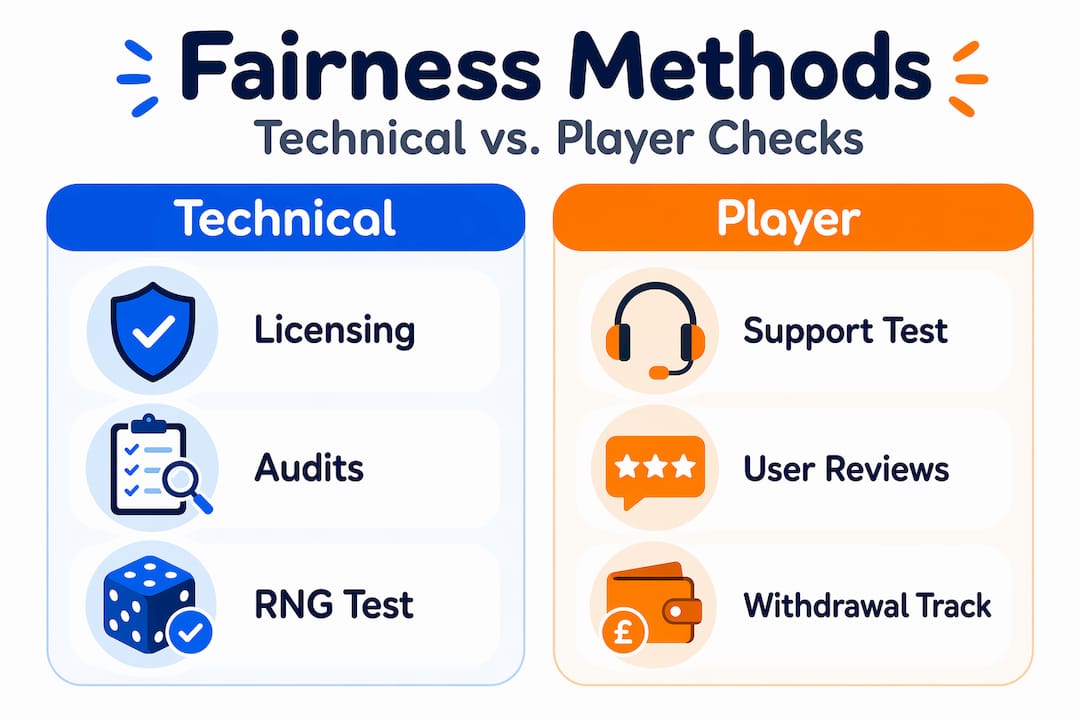
- Practical checks beyond the technical layer
- Comparing fairness evaluation methods
- My honest take on casino fairness signals
- Find verified fair casinos at Geekygambler
- FAQ
Key takeaways
| Point | Details |
|---|---|
| Licensing is the first check | Always verify a casino holds a valid UKGC licence before playing; it is the foundation of fairness assurance. |
| Third-party audits matter | Look for certificates from labs like eCOGRA or GLI, and confirm they cover the specific games you intend to play. |
| Provably fair adds live verification | Cryptographic tools let you personally verify individual bet outcomes, but only when correctly implemented. |
| Layered signals beat single badges | No single fairness badge is sufficient; combine licensing, audit certificates, RTP transparency, and player reviews. |
| Red flags are real | Vague fairness claims, outdated certificates, and unresponsive support are signs of a potentially dishonest operator. |
How to evaluate casino fairness: start with licensing
Before you look at any game mechanics or audit reports, the very first question to answer is whether the casino holds a licence from the UK Gambling Commission. The UKGC is the most rigorous gambling regulator in the world, and its licensing framework is built specifically to protect UK players. Operators must meet strict Licence Conditions and Codes of Practice that cover everything from game testing to advertising standards.
What does that actually mean for you? It means the casino has been vetted, is subject to ongoing compliance checks, and can have its licence suspended or revoked if it breaches its conditions. The UKGC has imposed penalties worth millions of pounds on operators that have failed to meet fairness and player protection requirements. That enforcement power is what makes the licence meaningful rather than cosmetic.
Verifying a licence takes under two minutes. Visit the UKGC’s public register at gamblingcommission.gov.uk, search for the casino name, and confirm the licence is active. A legitimate casino will also display its licence number in the website footer. Cross-referencing that number in the register is the definitive check.
Here is what to look for when assessing a UKGC-licensed casino:
- Active licence status on the public UKGC register
- Licence number visible in the footer or terms and conditions
- Named software and game suppliers listed with their own certifications
- Responsible gambling tools including deposit limits and self-exclusion
- Transparent terms without buried clauses that contradict stated conditions
Pro Tip: If a casino’s licence number does not appear in the UKGC register or the result shows a suspended licence, stop there. Do not deposit regardless of how attractive the bonus looks.
Understanding licensing is also covered in depth in Geekygambler’s guide on licensed casinos protecting UK players, which walks through exactly what the UKGC framework guarantees.
Third-party audits and RNG certification
Licensing tells you the casino operates legally. Audits tell you whether the games themselves are fair. These are not the same thing, and treating them as interchangeable is one of the most common mistakes UK players make.
Fair play audits verify RNG randomness, payout accuracy, and security measures using independent firms that have no financial interest in the casino’s outcomes. The process involves source code review, statistical randomness testing across millions of simulated spins, RTP confirmation against advertised figures, and a security assessment of the casino’s systems.
The UKGC requires that games are tested by approved labs before going live. The major approved testing laboratories to look for are:
- eCOGRA (eCommerce Online Gaming Regulation and Assurance)
- GLI (Gaming Laboratories International)
- iTech Labs
- BMM Testlabs
Each of these organisations publishes seal programmes. When a casino displays one of their seals, clicking it should take you to a live verification page on the auditor’s own website. If the link is broken or goes nowhere, treat that seal as unverified.
A crucial detail that most guides skip over: certificates are valid only for specific software versions. If the casino updates its game engine or switches to a new build without recertification, the old certificate is no longer a reliable indicator of fairness. RNG audits ensure that certified games produce statistically random outcomes aligned with their advertised RTP, but that assurance only holds for the version and configuration of the game that was actually tested. Always check the date on audit documents.
| Auditor | Key speciality | Seal verification |
|---|---|---|
| eCOGRA | RNG, RTP, and responsible gambling | Live seal on eCOGRA.org |
| GLI | Technical standards and compliance | Verification via GLI website |
| iTech Labs | RNG and statistical testing | Certificate database online |
| BMM Testlabs | Game maths and software integrity | Available through BMM portal |
Pro Tip: Look for the audit publication date on the certificate page, not just the casino’s claims. Anything older than 18 months without an updated report is worth querying with support before you play.
Understanding provably fair gaming
Provably fair is a different kind of verification, one that puts the tools in your hands rather than relying on a third party. It uses cryptographic techniques to let you personally confirm that neither you nor the casino could have manipulated a game’s outcome.
Here is how it works in practice. Before a game round begins, the casino commits to a server seed by providing you with a hashed version of it. You provide a client seed. These two inputs, combined with a nonce (a counter that increases with each bet), generate the game outcome. After the round, the casino reveals its original server seed. You can then feed all three values into a verification tool and reproduce the exact outcome independently.
The step-by-step process looks like this:
- Before betting, copy the server seed hash provided by the casino for that session.
- Note your client seed (you can usually customise this before a round).
- Record the nonce for the specific bet you want to verify.
- After the round, request the revealed server seed from the casino’s fairness page.
- Use the casino’s own verification tool, or an independent one, to input all three values.
- Confirm the output matches the result you received during play.
If the output does not match, that is a significant problem. Provably fair systems require the casino to commit to the server seed hash before bets are placed and to reveal all inputs afterward. Without that commitment step, there is no genuine guarantee. Weaknesses in the system typically occur when the casino controls the client seed or when the verification tool does not accurately reflect the game algorithm. Manual or partial reveals rather than automatic ones are a warning sign.
Provably fair is most common on crypto casinos and some newer platforms. It complements traditional auditing but does not replace it. A casino with provably fair tools but no UKGC licence is still operating outside the regulatory framework that protects you.
Pro Tip: Always verify using an independent tool rather than only the one the casino provides. If the casino’s verification tool gives a different result than an independent calculator, that discrepancy needs explaining.
Practical checks beyond the technical layer
Technical verification is powerful, but most players will not spend time checking seed hashes on every session. That is fine. There are practical, less technical signals that are equally telling when assessing casino fairness on a day-to-day basis.

Fairness assessment is multi-part, covering RNG implementation, payout verification, and overall security compliance. Transparency across all three of those areas is what separates honest operators from those trying to obscure the picture. A genuinely fair casino has nothing to hide and makes its documentation easy to find.
Practical checks to run on any new casino:
- RTP disclosure. Published return-to-player figures for individual games should be readily available, not buried in small print or vague ranges.
- Audit report accessibility. Third-party audit reports or at minimum a link to a live auditor seal should appear in the casino footer or dedicated fairness page.
- SSL and security. SSL encryption protects player data and financial transactions. A missing padlock in the browser bar is an immediate red flag.
- Player reviews and complaints. Check independent review forums. Look specifically for patterns of slow payments, ignored bonus disputes, or inconsistent game results.
- Support responsiveness. Test live chat before you deposit. An unhelpful or evasive support team is a reliable indicator of how complaints will be handled later.
Transparency and layered verification of fairness is the most practical approach to protecting yourself when playing at UK online casinos. No single signal is conclusive. The combination of multiple positive indicators across licensing, auditing, and published data is what builds genuine confidence.
Geekygambler’s dedicated piece on fair play safeguards goes deeper into what these protections look like across specific casino types and game formats.
Comparing fairness evaluation methods
Different methods address different parts of the fairness question. Using all of them together gives you the most complete picture.
| Method | What it checks | Reliability | Player effort |
|---|---|---|---|
| UKGC licensing | Legal compliance and ongoing oversight | High, legally enforced | Low, quick register check |
| Independent audit (eCOGRA, GLI, etc.) | Software randomness and payout accuracy | High, if certificate is current | Low to medium |
| Provably fair verification | Individual bet outcome accuracy | High, if correctly implemented | Medium to high |
| RTP transparency | Published payout rates vs. actual outcomes | Moderate, depends on disclosure | Low |
| Player reviews and complaint history | Operator behaviour and payment patterns | Moderate, anecdotal but informative | Low |
Relying on a single badge is not sufficient. The table above illustrates why: each method has a different scope and a different blind spot. Licensing does not verify individual game algorithms. Audits confirm software at a point in time. Provably fair is only available on certain platforms. Player reviews capture real-world behaviour that none of the technical checks fully predict. Layered assurance across multiple signals is the only way to form a well-rounded assessment.
My honest take on casino fairness signals
I have spent years reviewing UK online casinos, and the single biggest mistake I see players make is treating a fairness badge as if it were an off switch for scepticism. It is not.
In my experience, the casinos that are actually fair do not lean heavily on their badges. They make their licence number obvious, publish RTP figures per game, link to live audit seals, and their support team will tell you exactly where to find their testing certificates without being asked twice. That combination is more convincing than any quantity of logos on a homepage.
What I have found genuinely useful is testing the support team before depositing. Ask them specifically which lab certified their main slot library and whether you can see the report. The answer tells you almost everything. A competent, transparent team answers immediately. An evasive or dismissive response tells you more than any seal ever could.
My honest concern with provably fair systems is that most players never actually verify them, which makes their presence partly symbolic. The technology is sound when correctly implemented, but as I noted above, partial or manual seed reveals significantly weaken the guarantee. If a casino claims provably fair but makes the verification process confusing or incomplete, that is a red flag, not a mark of reassurance.
Walk away from licensed sites too if they show a pattern of payment delays, bonus disputes that consistently go in the casino’s favour, or terms that seem designed to trap players rather than protect them. A licence means oversight exists. It does not guarantee that a particular operator is behaving fairly in practice. Your job is to keep checking.
— Traffic
Find verified fair casinos at Geekygambler
If working through every check manually sounds time-consuming, Geekygambler has already done much of the groundwork for you.

Geekygambler’s UK casino reviews cover licensing status, audit certifications, RTP transparency, and player feedback for each operator, giving you a consolidated fairness verdict rather than a list of marketing claims. For players looking to make the most of their first deposit, the best casino bonuses page lists offers from vetted operators where the terms have been assessed for clarity and fairness. You can also explore certified game providers to understand which software studios back the games at any given casino. Every review on Geekygambler is built around the same layered evaluation framework this article describes, so you know exactly what standard has been applied.
FAQ
How do I check if a casino is licensed in the UK?
Visit the UK Gambling Commission’s public register at gamblingcommission.gov.uk and search for the casino by name. A legitimate operator will also display its licence number in the site footer, which you can cross-reference directly in the register.
What is an RNG audit and why does it matter?
An RNG audit is an independent review of a casino’s random number generator software, carried out by an approved lab such as eCOGRA or GLI. It confirms that game outcomes are genuinely random and that actual payouts align with the advertised return-to-player percentage.
Can I personally verify if a casino game is fair?
Yes, on platforms that offer provably fair gaming. You can use the server seed hash, client seed, and nonce from any completed bet to reproduce the outcome independently using a verification tool, confirming no manipulation occurred.
What are the signs of a rigged casino?
Key warning signs include unlisted or suspended UKGC licences, audit seals that link to broken or empty pages, unavailable or vague RTP information, a history of unresolved player complaints, and support teams that cannot explain their certification clearly.
Is a single fairness certificate enough to trust a casino?
No. Certificates cover specific software versions and can become outdated after updates. Combining current licensing, recent audit reports from approved labs, published RTP figures, and independent player reviews gives a far more reliable assessment of any casino’s honesty.
