

Are UK online gambling winnings taxable? Full guide
TL;DR:
- Most UK players are not required to pay tax on gambling winnings because operator-paid duties protect their earnings.
- However, if gambling activity resembles a trade due to frequency, organization, or profitability, HMRC might consider winnings taxable income, requiring professional advice.
Most UK players are sitting on a legal privilege they barely know about. Gambling winnings are not taxed as Income Tax or Capital Gains Tax for individual players in the UK, which makes Britain one of the most player-friendly jurisdictions on earth. Yet confusion still runs rampant, largely because players compare their experience to the heavily taxed systems in the United States and parts of Europe. This guide cuts through the noise, explains exactly where UK law stands, and flags the rare situations where tax might actually apply to you.
Table of Contents
- How UK law treats your online gambling winnings
- When could your gambling winnings ever be taxable?
- Other ways gambling winnings might trigger tax
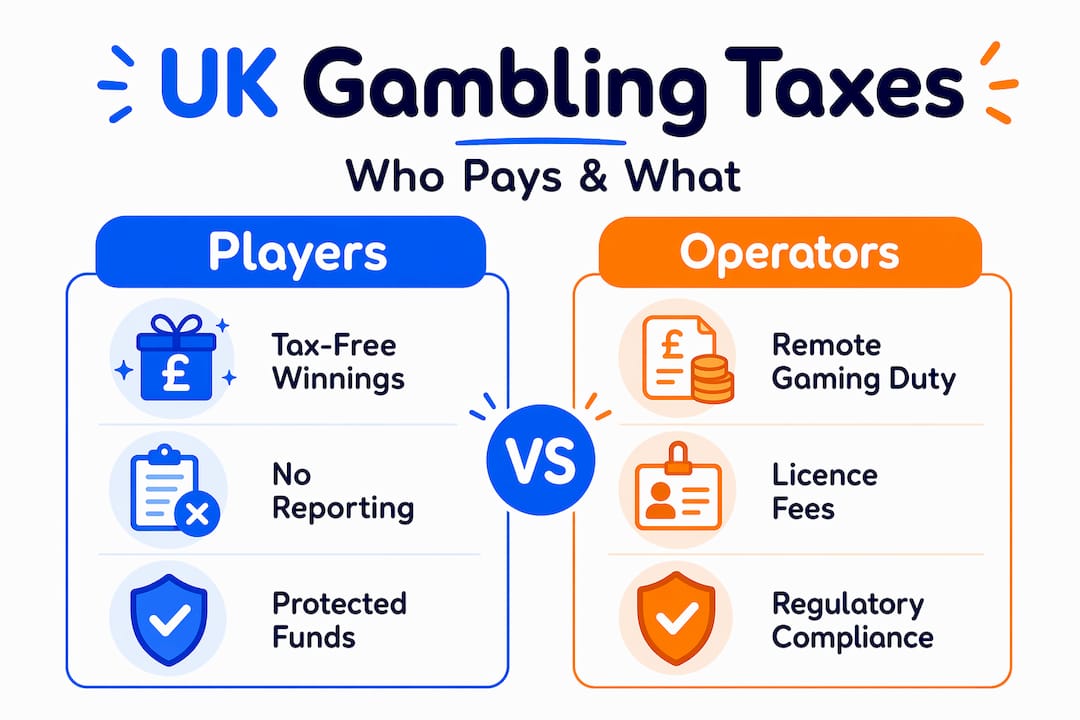
- Who pays gambling taxes in the UK and how regulation protects you
- Why the myth of ‘tax-free winnings’ still trips up UK gamblers
- Next steps: play smart and tap trusted resources
- Frequently asked questions
Key Takeaways
| Point | Details |
|---|---|
| Winnings usually untaxed | Most UK players do not pay any tax on gambling winnings from licensed operators. |
| Operator pays the duty | Gambling taxes are paid by the operators, not by individual gamblers. |
| Beware business-like activity | If your gambling resembles a business, HMRC could treat your winnings as taxable income. |
| Interest is taxable | Income earned from investing your winnings, such as interest, is taxable and must be declared. |
| Keep records and stay compliant | Simple record keeping helps you track winnings and any taxable downstream income to stay on the right side of the law. |
How UK law treats your online gambling winnings
Before anything else, it helps to understand what the law actually says and why it was written this way.
In UK tax law, a “winning” from gambling is not treated as “income” in the conventional sense. Income Tax applies to earnings from employment, self-employment, and certain investments. Capital Gains Tax applies to profits from selling assets. Gambling winnings fit neither category because gambling is legally viewed as a leisure activity rather than a commercial venture. The logic is straightforward: if you can lose money on a bet, the gain cannot be reliably classified as earned income.
The entity that does pay tax is the operator, not you. Under UK law, gambling duties are paid by operators, not players. HMRC administers these through specific levies including Remote Gaming Duty and General Betting Duty. When you spin a slot or place a football accumulator, the casino or bookmaker has already accounted for their tax obligation before you even log in.
HMRC’s position, in plain terms: Individual players do not have a tax liability on gambling winnings from UK-licensed operators. The operator pays duties to HMRC; the player keeps their winnings in full.
This is fundamentally different from the United States, where players must report all gambling winnings as taxable income and operators are required to issue tax forms above certain thresholds. In several EU countries, a withholding tax is deducted directly from large wins. The UK chose a different path, placing the fiscal burden entirely on operators, which is one reason why understanding UK gambling laws matters for anyone who plays regularly.
Here is a quick comparison of how the UK system stacks up against other major jurisdictions:
| Country | Player pays tax on winnings? | Operator pays duty? | Notes |
|---|---|---|---|
| United Kingdom | No | Yes | Remote Gaming Duty, General Betting Duty |
| United States | Yes | Yes | Federal + state taxes may apply |
| Germany | Yes (since 2021) | Yes | 5% tax on stakes in some categories |
| Ireland | No | Yes | Similar model to UK |
| France | Varies | Yes | Depends on game type |
As a UK resident playing at a licensed site, you fall into the most favourable column. The key benefits for players include:
- No requirement to report winnings on a tax return
- No tax deducted at source from your withdrawals
- No threshold above which winnings become taxable
- No distinction between small wins and jackpot amounts
- Freedom to use winnings however you choose without a tax consequence at point of receipt
Staying informed about responsible gambling in the UK remains important regardless of the tax position, but at least you can do so without worrying that the taxman will take a cut of your lucky streak.
When could your gambling winnings ever be taxable?
While the general rule is reassuring, there is a genuine exception that serious players must understand. It is relatively rare, but it carries significant consequences if it applies to you.
Gambling activity can become taxable if HMRC decides it amounts to a trade. The word “trade” here has a specific legal meaning. It refers to activity carried out in an organised, systematic, and profit-seeking way, similar to running a business. If your gambling starts to look less like leisure and more like a profession, HMRC may take a very different view.
HMRC does not publish a definitive checklist, but tribunals and case law have established a set of indicators. These are commonly referred to as the “badges of trade” and include factors such as frequency of transactions, the degree of organisation, whether you use a system or method, the level of profit motive, and whether gambling is your primary source of income. No single factor is conclusive, but a combination of several creates risk.
Here is how a casual player differs from someone who might attract HMRC scrutiny:
| Trait | Casual gambler | Potential ‘trader’ |
|---|---|---|
| Frequency | Occasional or weekly | Daily, systematic sessions |
| Record keeping | None or minimal | Detailed logs, spreadsheets |
| Income dependency | Supplementary | Primary or sole income |
| Strategy | Entertainment-based | Data-driven, systematic |
| Scale of activity | Small to moderate stakes | High stakes, large volume |
| Skill element | Random/luck-based | Skill-based (e.g., poker, sports trading) |
Professional poker players and matched bettors who earn consistently and substantially are the most likely individuals to fall within these parameters. That said, even here the law is not entirely settled. UK courts have generally been reluctant to classify gambling as a trade, but the risk is real enough that it warrants attention.
Pro Tip: If you earn more from gambling than from your employment over a sustained period, or if you gamble in a highly organised and methodical way, speak to a qualified accountant before assuming your winnings are automatically tax free. The cost of one professional consultation is far less than an unexpected HMRC inquiry.
If you suspect your activity might cross the line into trading, here are the steps you should take:
- Gather your records. Document your wins, losses, methods, and session frequency over the past 12 months.
- Calculate your net position. Work out whether you are consistently profitable and at what scale.
- Assess your dependency. Consider how much of your household income comes from gambling.
- Seek professional advice. Consult a tax accountant who has experience with gambling licensing rules and HMRC compliance.
- Register if advised. If a professional confirms that your activity constitutes a trade, register for Self Assessment with HMRC promptly to avoid penalties.
Other ways gambling winnings might trigger tax
Even when your winnings themselves are completely tax free, what you do with the money afterwards can still create a tax obligation. This is the nuance that many players completely overlook.
Interest generated from winnings is taxable, even though the original winnings were not. If you deposit £20,000 of casino wins into a savings account and earn £800 in interest over the year, that £800 is taxable income under standard rules. The same principle applies if you invest winnings in stocks and receive dividends, or if you purchase a buy-to-let property with gambling proceeds and collect rental income.

The gambling wins themselves remain untouched by HMRC. But any income those wins then generate flows back into the ordinary tax system. This catches a surprising number of people off guard, particularly those who have had a genuinely life-changing win.
Practical examples of downstream taxable income include:
- Savings interest above your Personal Savings Allowance (£1,000 for basic rate taxpayers, £500 for higher rate taxpayers in 2026)
- Dividend income from shares purchased with winnings, above the annual dividend allowance
- Rental income from property acquired using gambling funds
- Self-employment income if you teach others how to gamble profitably or write about it commercially
- Crypto gains if you convert winnings into cryptocurrency and later sell at a profit
Pro Tip: You do not need to keep detailed records of every gambling session unless you are a suspected trader. But if your wins have significantly boosted your savings or investment portfolio, it is worth noting where the funds originated. This helps you separate taxable returns from the original tax-free capital if HMRC ever asks questions. Understanding tax and payment methods at your chosen casino can also help you keep cleaner financial records from the outset.
Good financial hygiene is not about paranoia. It is simply about having clear, credible records should any question ever arise.
Who pays gambling taxes in the UK and how regulation protects you
Understanding the structure of UK gambling taxation explains why players are so well protected, and gives context to the entire regulatory framework.
Operators who hold a UK Gambling Commission licence and offer services to UK residents are subject to a range of gambling duties administered by HMRC. The two most significant for online players are Remote Gaming Duty and General Betting Duty.
| Duty type | Who it applies to | Rate (as of 2026) | What it covers |
|---|---|---|---|
| Remote Gaming Duty | Online casino operators | 21% of gross gaming yield | Slots, table games, live casino |
| General Betting Duty | Bookmakers and spread betters | 15% of net receipts | Sports betting, fixed-odds wagers |
| Pool Betting Duty | Pool operators | 15% of net pool | Football pools and similar |
These gambling duties are borne by operators and built into the economics of the product. In simple terms, the house edge and margin you compete against already accounts for the operator’s tax burden. You never see the duty as a line item, because it is their responsibility, not yours.
This structure benefits players in several ways:
- You receive your full winnings without any deduction at source
- There is no administrative burden on you to report ordinary wins
- Operators are commercially motivated to offer competitive odds and bonuses because their margins account for all costs including tax
- The regulatory framework under gambling regulation and safety standards ensures operators meet their obligations before they can serve you
If you ever have a genuine query about your own tax position relating to gambling, HMRC provides a dedicated contact route for gambling duties enquiries. For personal tax questions, the Self Assessment helpline is the appropriate channel. Do not assume a gambling-duties contact will handle personal Income Tax queries, as these are handled separately.
The UKGC casino safety actions in recent years have further strengthened the framework, ensuring that licensed operators remain accountable to both players and HMRC simultaneously.
Why the myth of ‘tax-free winnings’ still trips up UK gamblers
Here is our honest take, having spent years covering the UK gambling landscape.
The confusion around gambling tax is not random. It is structural. Most gambling content online is produced for a global audience, and global usually means American. The US system, where you owe federal tax on every dollar you win and operators are legally required to report large payouts, gets treated as the default. UK players read that content and worry unnecessarily.
The second source of confusion is social. People who have had a big win sometimes do not tell anyone, partly out of superstition and partly because they assume the government will want a share. Friends and family perpetuate the myth by saying things like “you’ll have to pay tax on that.” They mean well but they are wrong, at least in the UK.
What genuinely does trip players up is the business-activity question. We have seen cases, both reported and anecdotal, where a player who was genuinely just a serious recreational gambler attracted unwanted attention simply because their bank account showed large, regular gambling-related transactions. The appearance of business-like behaviour, even without the underlying intent, can prompt enquiries. Keeping a simple record, even a basic spreadsheet of your sessions, gives you a credible paper trail that confirms the recreational nature of your activity.
The downstream income point also tends to catch people out after a substantial win. Winning £50,000 at an online casino is entirely tax free. Putting it in a high-yield savings account and earning £2,500 in interest is not. That distinction matters once wins reach a meaningful size.
Our advice is this: relax about the wins themselves, but stay thoughtful about what you do with the money afterwards. Visit our safer gambling guide to stay informed about the full picture of playing wisely in the UK.
Next steps: play smart and tap trusted resources
Now that you understand the tax picture clearly, you are in a strong position to enjoy online gambling in the UK with genuine peace of mind.

Playing with licensed UK operators means your winnings are already protected by the operator-pays duty model, and you have access to the full range of responsible gambling tools required by the UKGC. At Geeky Gambler, we review and verify casinos specifically for UK players, checking licensing, fairness, security, and payment reliability before recommending anything. If you want to make the most of your play, browsing our curated list of best online casino bonuses is a smart starting point. Every offer we feature is from a licensed operator, which means your winnings stay yours.
Frequently asked questions
Do UK gambling sites report my winnings to HMRC?
No, UK gambling operators do not report individual players’ winnings to HMRC because personal winnings are not taxed as income or capital gains for UK residents.
Do I need to declare gambling winnings on my self-assessment tax return?
No, you do not need to declare typical gambling winnings from UK licensed operators. The only exception is if HMRC determines that your gambling amounts to a trade, at which point self-employment income tax rules may apply.
Are foreign gambling winnings taxed differently in the UK?
Gambling winnings from foreign operators are generally not taxed for UK residents either, since UK tax law does not tax gambling income at the personal level. Always check whether a foreign jurisdiction applies withholding tax before you play abroad.
What should I do if I earn interest on my gambling winnings?
You must report any interest or other income earned on winnings through your usual Self Assessment tax return, as the income generated by gambling funds is fully taxable under standard rules.

