

How blockchain makes online casinos fairer and safer
TL;DR:
- Blockchain provides transparent, tamper-proof records for online casino transactions and game outcomes.
- Provably fair systems enable players to independently verify fairness using cryptographic schemes.
- UK players should prioritize licensed casinos for legal protections, as many blockchain sites are offshore.
Most UK players have wondered at some point whether online casino games are genuinely random or quietly tilted in the house’s favour. It’s a fair concern. Traditional casino software runs on hidden algorithms, and you’re largely expected to trust the operator. Blockchain technology changes that equation entirely. Instead of accepting a casino’s word, you can independently verify every bet, outcome, and payout using publicly accessible records. This guide explains exactly how blockchain works inside online casinos, what provably fair gaming means in practice, and what UK players genuinely need to watch out for before diving in.
Table of Contents
- What is blockchain and how does it work in online casinos?
- How blockchain ensures provable fairness in games
- Security and transparency: How blockchain protects your bets
- Limits and legal barriers: What UK players should know
- The truth about blockchain casinos: What most guides don’t tell you
- Find safe and rewarding blockchain-friendly casinos
- Frequently asked questions
Key Takeaways
| Point | Details |
|---|---|
| Blockchain brings transparency | Every bet and outcome is recorded immutably so players can verify fairness and payouts themselves. |
| Provably fair games explained | Cryptographic tools let you check for tampering, giving more agency than traditional random number generators. |
| Regulatory challenges exist | Most blockchain casinos aren’t UK-licensed, so legal protections and responsible gambling tools differ. |
| Security is enhanced | Player funds and data are protected with blockchain’s advanced security and smart contract features. |
What is blockchain and how does it work in online casinos?
Think of a traditional online casino as a locked filing cabinet. The casino controls the records, and you only see what they choose to show you. A blockchain flips that model completely. It’s a decentralised digital ledger, meaning records are stored across thousands of computers simultaneously rather than on a single server controlled by one company.
Every transaction, every bet placed, and every outcome is written into a “block.” Each block links to the one before it, forming a chain that cannot be altered without rewriting every block that follows. This makes falsification practically impossible. Nobody, not even the casino itself, can quietly edit a past result.
In online casinos, this means game data is recorded publicly. When you place a bet on a blockchain-based slot or dice game, that wager, the result, and the payout are all written to the ledger. As blockchain’s immutable ledger shows, this recording allows for independent player verification and public auditability, making it fundamentally different from anything traditional casino software offers.
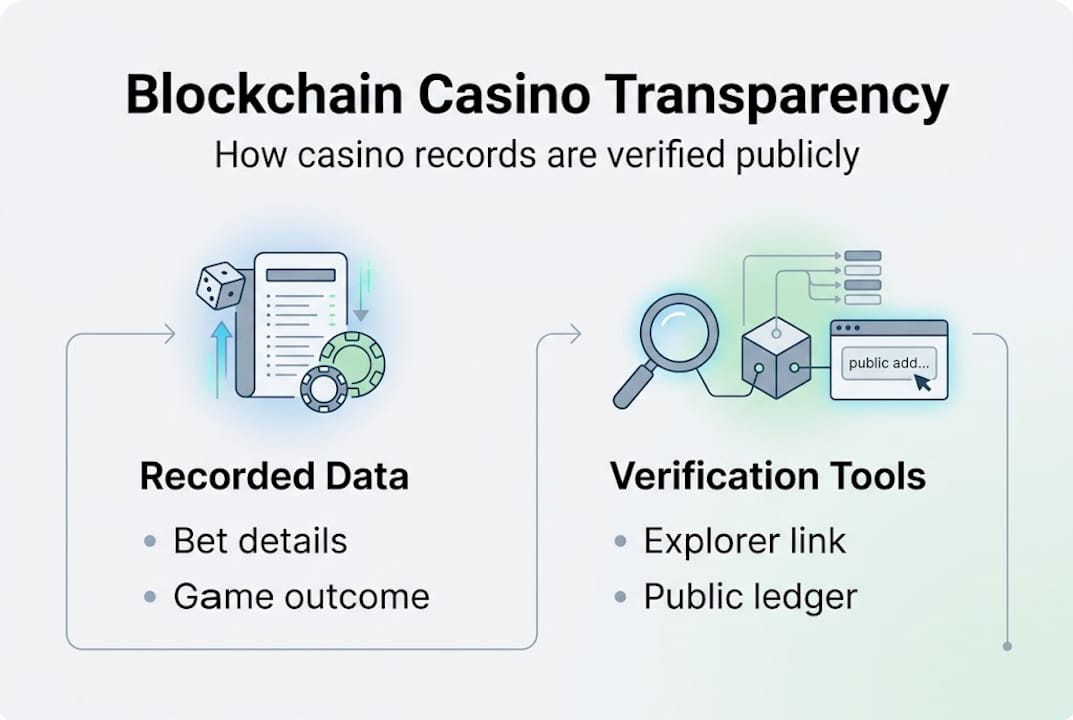
Here’s a quick breakdown of how blockchain casino transactions differ from conventional ones:
| Feature | Traditional casino | Blockchain casino |
|---|---|---|
| Transaction records | Private, controlled by operator | Public, on-chain ledger |
| Outcome verification | Requires trusting the casino | Independent verification possible |
| Data tampering | Possible without detection | Virtually impossible |
| Payment processing | Days via banks or e-wallets | Near-instant via cryptocurrency |
| Anonymity | Full KYC required | Partial or full anonymity |
Key features that make blockchain stand out in gambling include:
- Immutability: Once a record is written, it cannot be changed
- Transparency: Any player can browse the public ledger using a blockchain explorer
- Decentralisation: No single entity controls the database
- Speed: Cryptocurrency payouts settle far faster than bank transfers
- Smart contracts: Self-executing agreements that pay out automatically when conditions are met
If you’re new to this space, our cryptocurrency casinos guide covers the broader landscape of crypto gambling for UK players, including which coins are most commonly used and how deposits work in practice.
Pro Tip: Most blockchain casinos have a dedicated blockchain explorer link in their game history. Paste your transaction ID there and you’ll see a real-time, tamper-proof record of every bet you’ve made.
How blockchain ensures provable fairness in games
“Provably fair” is one of those phrases that gets thrown around a lot in crypto gambling circles, but it has a very specific technical meaning. It refers to a cryptographic system that lets players independently confirm that a game result was generated fairly, before and after the round takes place.
The provably fair mechanism works through a commit-reveal scheme combining three components: a server seed, a client seed, and a nonce.
Here’s how that actually plays out in a game round:
- Before the game starts, the casino generates a server seed and sends you a hashed (encrypted) version of it. Hashing means you can see a fingerprint of the seed without knowing the actual value, so the casino can’t change it later.
- You provide a client seed, either automatically by your browser or manually if you want maximum control. This is your input into the outcome.
- A nonce (a round counter that increases by one with every game) is added to ensure every round produces a unique result even if your seeds remain the same.
- After the round, the casino reveals the original server seed. You can combine all three values using the HMAC-SHA256 algorithm and confirm that the outcome matches what was declared. If it doesn’t match, you have cryptographic proof the game was tampered with.
This is a significant leap beyond traditional random number generation (RNG). Here’s how the two approaches compare:
| Factor | Provably fair (blockchain) | Traditional RNG |
|---|---|---|
| Player verification | Yes, independently verifiable | No, must trust audit reports |
| Transparency | Fully public | Limited to third-party audits |
| Manipulation detection | Mathematically provable | Requires external regulator |
| Player seed control | Yes | No |
| Audit frequency | Continuous, every round | Periodic |
It’s worth exploring the RNG vs provably fair comparison in more detail if you’re weighing up which type of casino to use. Traditional RNG is not inherently dishonest. Reputable operators have their software audited by independent labs like eCOGRA. But provably fair gives you the maths itself rather than asking you to rely on someone else’s audit.
Pro Tip: Look for blockchain casinos that let you manually input your own client seed before each game. This gives you personal control over your input into the result, making it even harder for any single party to influence the outcome.
Security and transparency: How blockchain protects your bets
Fairness and security are related but distinct concerns. A casino could be provably fair on results yet still mismanage your funds or expose your personal data. Blockchain addresses both, though in ways that require some explanation.

Every transaction on a public blockchain is permanently recorded and publicly accessible. This applies not just to game outcomes but to deposits, withdrawals, and bonus payments. Records recorded immutably on the ledger allow any player to verify payouts independently, without relying on the operator’s internal reports or annual audits.
Smart contracts add another layer of security. These are self-executing pieces of code stored on the blockchain. When a jackpot is triggered or a bet wins, the smart contract pays out automatically according to pre-written rules. There’s no human intervention, no approval process, and no risk of the casino choosing to delay or withhold payment. The code runs as written.
“The key advantage of smart contracts in gambling is that the outcome and payout logic are determined by code, not by a person. No employee can override it, no manager can reverse it, and no financial crisis at the operator can delay it.”
Compare this to traditional online casinos, where your funds sit in the operator’s internal wallet. If a casino faces financial difficulty or decides to withhold withdrawals, you’re at the mercy of their goodwill and your local regulator.
Here are the core security features blockchain casinos offer UK players:
- Immutable records: All bets and payouts are permanently stored and publicly verifiable
- Smart contract payouts: Winnings are released automatically by code, not manually by staff
- Pseudonymous play: Many blockchain casinos require only a wallet address, protecting personal data
- Reduced custodial risk: Funds held in smart contracts rather than operator-controlled accounts
- Transparent RTP: Return-to-player rates can be verified on-chain rather than simply stated
Before depositing at any online casino, reviewing general casino security tips is well worth your time. And if you want to understand how payment providers factor into your security picture, this breakdown of payment security at UK casinos is highly relevant, particularly for anyone moving funds between a crypto wallet and traditional banking methods.
Limits and legal barriers: What UK players should know
Here’s where things get complicated. Blockchain’s benefits are genuine, but UK players face a specific legal landscape that makes many blockchain casinos difficult or even risky to use.
Most blockchain and crypto casinos operate offshore. They hold licences from jurisdictions like Curaçao or Malta but are not authorised by the UK Gambling Commission (UKGC). Regulatory barriers for UK gamblers mean that while offshore crypto casinos offer transparency benefits, they don’t carry the same protections as UKGC-licensed operators.
What does that actually mean for you? Quite a lot. A UKGC licence requires the casino to ring-fence your funds, participate in dispute resolution schemes, apply responsible gambling tools like deposit limits and self-exclusion, and submit to regular independent audits. Offshore casinos may offer none of these protections. Understanding UK gambling laws is essential before you hand over any money, especially when crypto is involved.
There are also implementation flaws worth knowing about. Not every provably fair system is equally robust. Some casinos reuse server seeds too infrequently, making it theoretically easier to reverse-engineer outcomes. Others rely on “oracles,” which are external data feeds that introduce a point of potential manipulation outside the blockchain. And in practice, very few players actually verify their results, which means the theoretical transparency advantage often goes unused.
KYC (Know Your Customer) procedures are another complication. Some blockchain casinos skip identity checks to preserve anonymity, which sounds appealing but removes a layer of protection against fraud and money laundering. Responsible platforms still carry out KYC verification even when using crypto, and this is actually a positive sign. Understanding the role of regulation in UK gambling clarifies why these checks exist and why bypassing them often signals a less trustworthy operator.
Dos and don’ts for UK players considering blockchain casinos:
- Do check whether the casino holds a UKGC licence or another reputable licence
- Do verify provably fair claims yourself rather than just taking the marketing at face value
- Do use small test deposits before committing significant funds to any new platform
- Don’t assume anonymity equals safety. Unlicensed sites have less accountability
- Don’t ignore responsible gambling tools. If a site doesn’t offer deposit limits, that’s a red flag
- Don’t gamble at offshore sites thinking blockchain transparency replaces regulatory protection. It doesn’t
The truth about blockchain casinos: What most guides don’t tell you
We’ve covered the technology honestly, and here’s what we at Geeky Gambler genuinely believe after reviewing the space carefully: blockchain is a real and meaningful improvement in casino transparency, but the industry routinely overhypes what it delivers in practice.
The uncomfortable truth is that most players never verify a single result. The tools are there, the maths works, and the logic is sound. But the verification rates are negligible. For the vast majority of users, a provably fair system functions identically to a trusted traditional casino because they’re not checking anything.
Meanwhile, UKGC-regulated casinos, while opaque on the technical mechanics, carry legally enforced protections you simply don’t get offshore. Dispute resolution. Fund segregation. Mandatory self-exclusion tools. These aren’t optional extras. They’re legal requirements.
Our honest take: use blockchain’s transparency features if you’re technically inclined and want that level of control. But never treat provably fair as a substitute for proper licensing. Before placing large bets anywhere, review casino audit standards to understand what genuine oversight looks like. Blockchain is a powerful tool. It’s not a regulatory framework.
Pro Tip: Treat provably fair verification like reviewing your bank statement. You may not do it every transaction, but run the check on any large win or suspicious outcome. The tools are free and take under two minutes.
Find safe and rewarding blockchain-friendly casinos
Ready to put your new understanding into practice? Here’s where to start your search for reputable, rewarding blockchain casino options.
At Geeky Gambler, we’ve done the hard work of reviewing and vetting casinos so you don’t have to guess. Whether you’re after exciting crypto-compatible titles or generous welcome packages, you’ll find handpicked recommendations from our team.

Browse our curated selection of best online casino bonuses to find offers that work alongside crypto deposits, including free spins and matched welcome bonuses from verified operators. If you want to explore blockchain-native game design, BGaming casino games feature some of the most innovative provably fair titles available to UK players right now. For a full picture of your options, our expert casino reviews cover licensing, security, and game quality in the detail you deserve.
Frequently asked questions
How does blockchain make online casinos fairer?
Blockchain records bets and outcomes on a public ledger, letting anyone independently verify every win and payout rather than simply trusting the operator.
What is a provably fair game system?
A provably fair game uses a cryptographic commit-reveal scheme combining server seed, client seed, and nonce via HMAC-SHA256, so players can mathematically confirm results haven’t been altered.
Are blockchain casinos legal for UK players?
Most blockchain casinos are not UKGC-licensed, which means UK players may lack legal protections and should carefully check the operator’s licensing status before depositing.
Can I really verify online casino games myself with blockchain?
Yes, the tools exist and are free to use, though verification rates remain low in practice, meaning most players benefit from blockchain’s structure without actively checking results themselves.


